Unexpected MOB drill and other challenges

In a scene in the film Crimson Tide, the captain of a US nuclear sub (Gene Hackman) and his executive officer (Denzel Washington) disagree violently about the merits of purposefully staging a missile drill while simultaneously dealing with a serious galley fire.  The gist: Washington: “are you mad, doing that with all this chaos going on?”; Hackman: “this is exactly what you want – this is a ship of war and war is chaotic, so use these opportunities to practice”.

It felt a bit like that when, negotiating a tricky tidal situation south of the Orkneys, our man overboard recovery device exploded suddenly out of its housing, dropped into the water behind the boat and began to inflate.  Oh great!  We have renamed it Otto, after the unhelpful Airplane autopilot, and the rather similar humorous sound it made whilst inflating.

Although travelling east from the Orkneys, the cruising almanac recommends travelling 5 miles west of the exit from Scapa Flow before turning, to avoid being swept onto a nearby island by the east-going tide.  With a typically unhelpful wind direction, we were already further south than we wanted when Otto decided to jump ship.  A swift tack brought us back alongside and we recovered him back into the cockpit and resumed our original course.  He sat in the boat for the rest of the journey, getting in the way and gradually deflating, just like his namesake, although Helen decided not to re-inflate him.  On inspection, it seems Otto’s housing was wet inside (lots of rain recently), which must have triggered the automatic inflation; it was a good job we were around at the time, and was actually useful practice (we’re with Hackman on this).
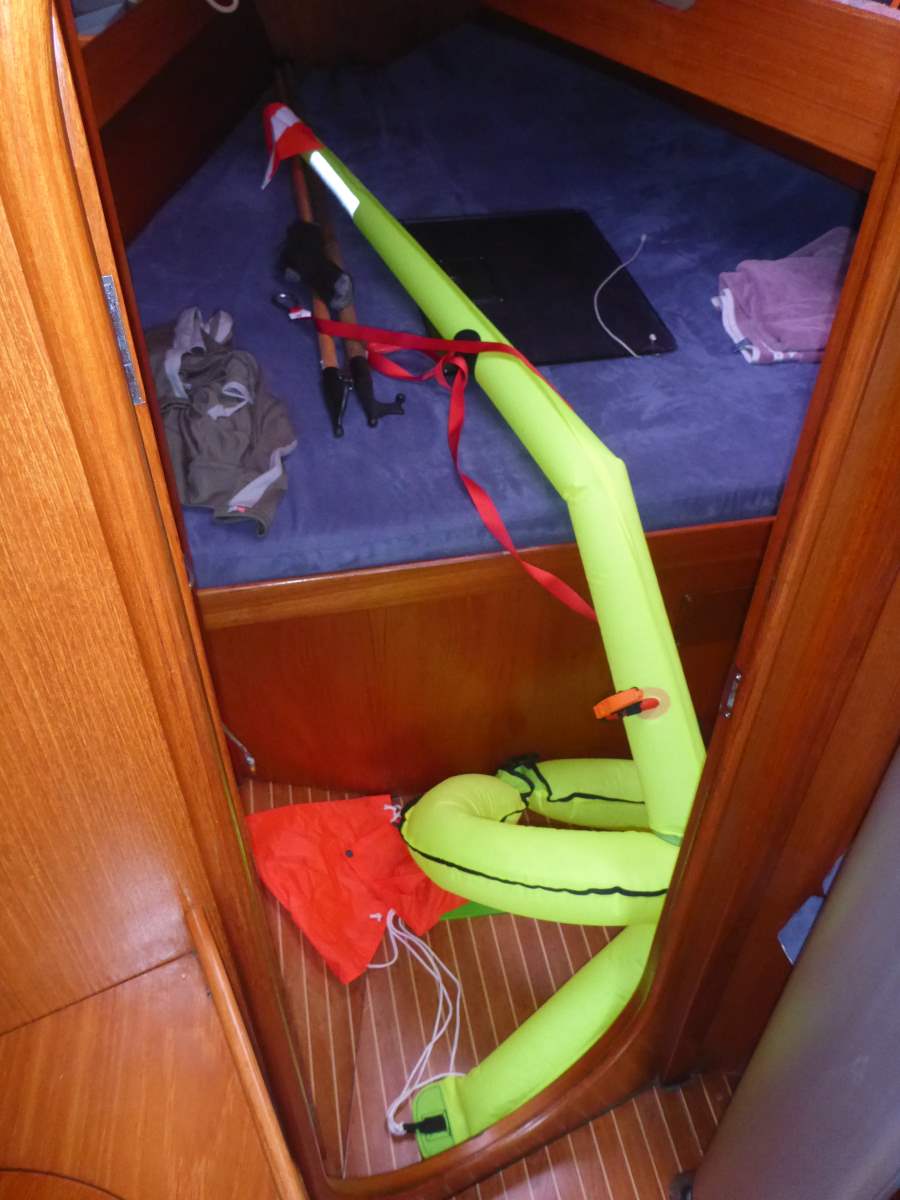
Day97 Otto
Otto deflates in the forecabin

The rest of the day was uneventful: in light winds we were outpaced down the Scottish coast by our rower, in spite of having the cruising chute up.  We anchored in Sinclair Bay while he carried on a few miles to Wick.  He won’t have been able to keep up with us in the strong winds we have had subsequently.  After a week in the Orkneys, we decided we needed to make up some ground and wanted to test ourselves on a longer passage.  So, we left Sinclair bay at 7am hoping to do a decent hop, ideally all the way to Edinburgh, which would be more than 200miles.

It wasn’t to be: after 24 hours we’d got as far as Peterhead when the wind died.  The guide book notes that by sailing a direct course to Peterhead, you miss the delightful coastline of the Moray Firth but, tacking with the wind on the nose all the way, we felt we’d seen more of the coast than we really needed as well as well as the oil platforms in the middle of the Firth.  Light winds were forecast for the following period and with limited stopping points for another 40 miles, we put into Peterhead with a mix of disappointment and relief at being able to rest.

As it happens, we liked Peterhead.  It is pleasingly industrial with huge fishing boats and pipelaying gear in the harbour.  A bit of an ‘80s town centre but the coffee was good and some of the buildings are pretty.  The owners of “Bay View” cottages may not appreciate the large hangers now obscuring the view of the bay though.

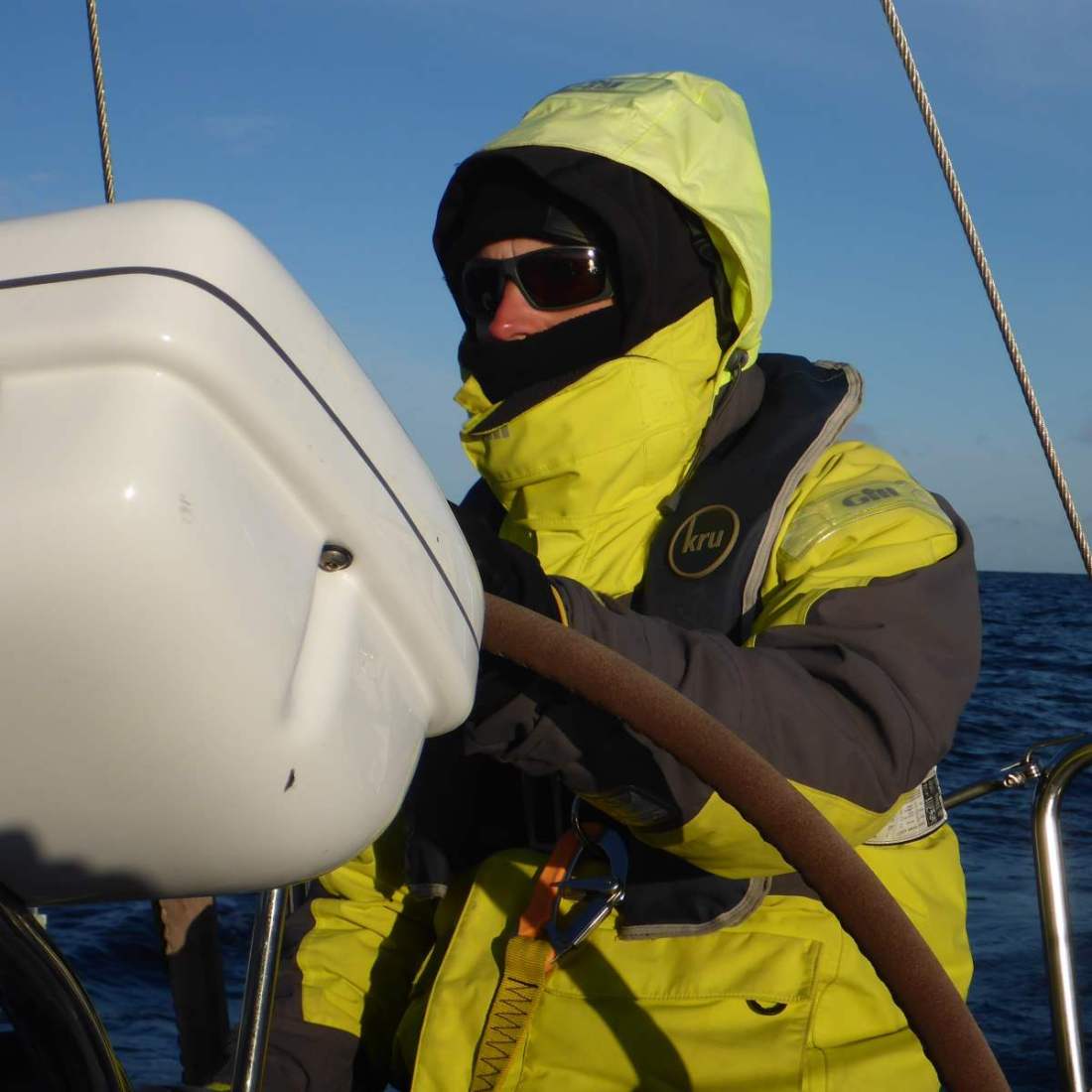
We carried on at 8:30 the following day, the 100th of our trip, marked by eating the final piece of our 2017 Christmas cake.  This journey proved one of the most challenging yet.  The headwinds continued, inconveniently adjusting as our course changed around the coast.  For most of the journey we had around 25 knots.  Beating into that for 30 hours was hard work!  The helm requires constant attention; in the dark it feels like you are holding the reins of some wild thing, galloping headlong.  Alex almost came a cropper when making tea, overbalancing and lifting a galley door off its hinges, then hitting himself in the head with it.  Fortunately, Helen is more sympathetic than Alex, as he would have found this very amusing had it been the other way around.

The noise is unbelievable: wind whining in the rigging, the whole boat vibrating and crashing through the waves.  We each got 30 minutes sleep here or there, between 90 minute shifts on the wheel, just about enough to keep functioning.  Climbing out of bed is literal: it’s on a 30 degree slope and you have to scramble uphill to get out.  For added challenge there is a lot more traffic on this part of the coast: we have become accustomed to being alone on the sea most of the time and suddenly there are large freighters and cruise lines tracking up and down the coast while we are tacking back and fro across their routes.

The conditions started to take their toll on Ventata.  Just before it got dark the genoa halyard snapped and we had to take the sail down to replace it with one of the spinnaker halyards.  Meant to replace it last year but didn’t get round to it.  Anyway, it was good exciting stuff on the foredeck with the boat leaping around.  Later there was a cracking sound in the cockpit as the block that secures the furling line failed, spraying bits and letting the heavily reefed sail out in full until we were able to winch it back in.  Noted afterwards that the critical parts were plastic not metal; we will be more aware of this in future…

By 6am we had got to May Island in reasonable shape, all things considered, and ready to head up the Firth of Forth.  The final 25 miles to Edinburgh was hard in terms of effort and patience.  In its usual generous way, the wind became westerly, forcing us to tack all the way up to Edinburgh.  With deep reefed sails, she doesn’t point well into the strong wind, so to make those 25 miles to windward we sailed 50 over the ground.  However, we made it!  In 4 days since leaving the Orkneys we were underway for 63 hours, 59 of them under sail.  We logged 358 miles, motoring for only 10 (mainly up the narrow channel that comes under the Forth bridges).  The following day we washed the salt out of the foul weather gear, bought a re-arming kit for the MOB device and 35 metres of nice new dyneema halyard which Alex has been up the mast to fit.  Now, sort of rested, we will see what Edinburgh has to offer!
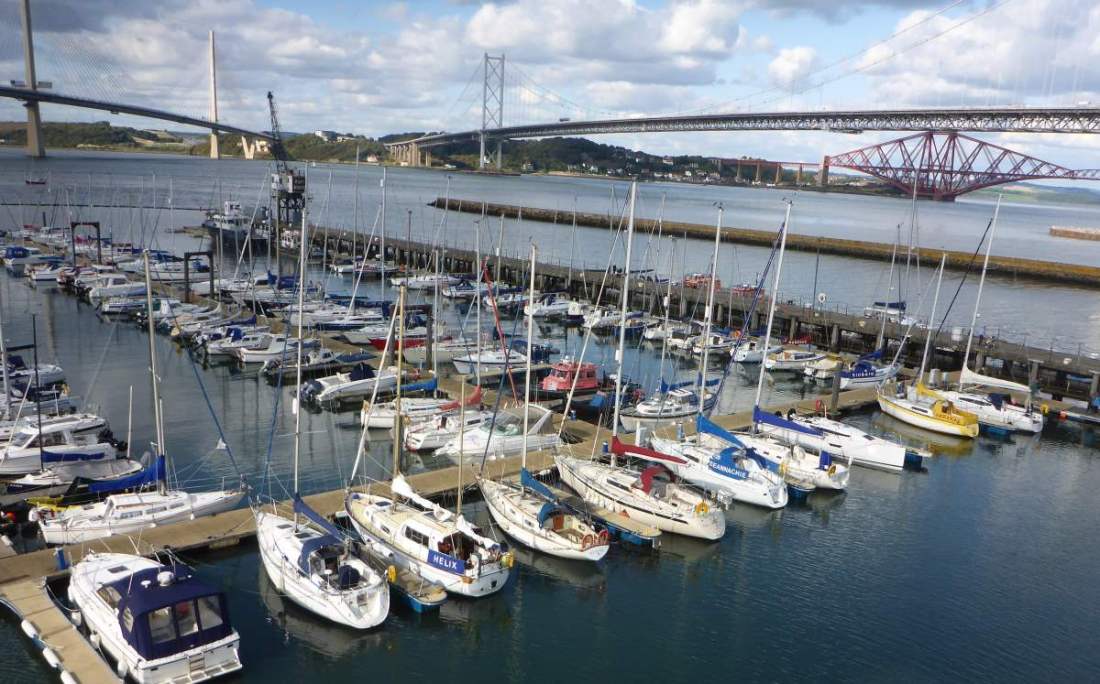
Day102 Port Edgar from masthead
View from the top of the mast, while rethreading the genny halyard in Port Edgar marina


Very nearly 59 degrees North!

We have reached what, barring the unexpected, will be our most northerly point: 58 degrees and 57.8 minutes north!  From here we will turn south – we are, oddly, feeling both sad about this and feeling there is still a long way to go.  Already we have sadly watched our longitude decrease from -8.5 West (Kinsale) to -6.5 (Isle of Canna) to -3 (Stromness).  (Incidentally, we have just updated the plot of our route on the other page if you are interested.)

Cape Wrath, despite the warnings in the pilot books, was benign.  We had an early start from Loch Laxford, a rocky corner 20 miles south of the cape where we anchored for 2 nights, sheltering from the wind and trying (unsuccessfully) to catch fish.  We soon found ourselves in the midst of the largest pod of dolphins we have seen yet; it’s also the first time we have seen them jumping out of the water.  We passed our round-Britain rower again (we saw him on the AIS, emerging from a different loch, just behind us).  Frustratingly, with little wind we had to use the motor for an hour to avoid the tide on the corner, which always upsets Helen.

Once “round the corner”, we continued our unsuccessful hunt for mackerel off the back of the boat.  We have concluded we are the worst fishermen at sea.  We need more weight on the line (so have just been to get some).

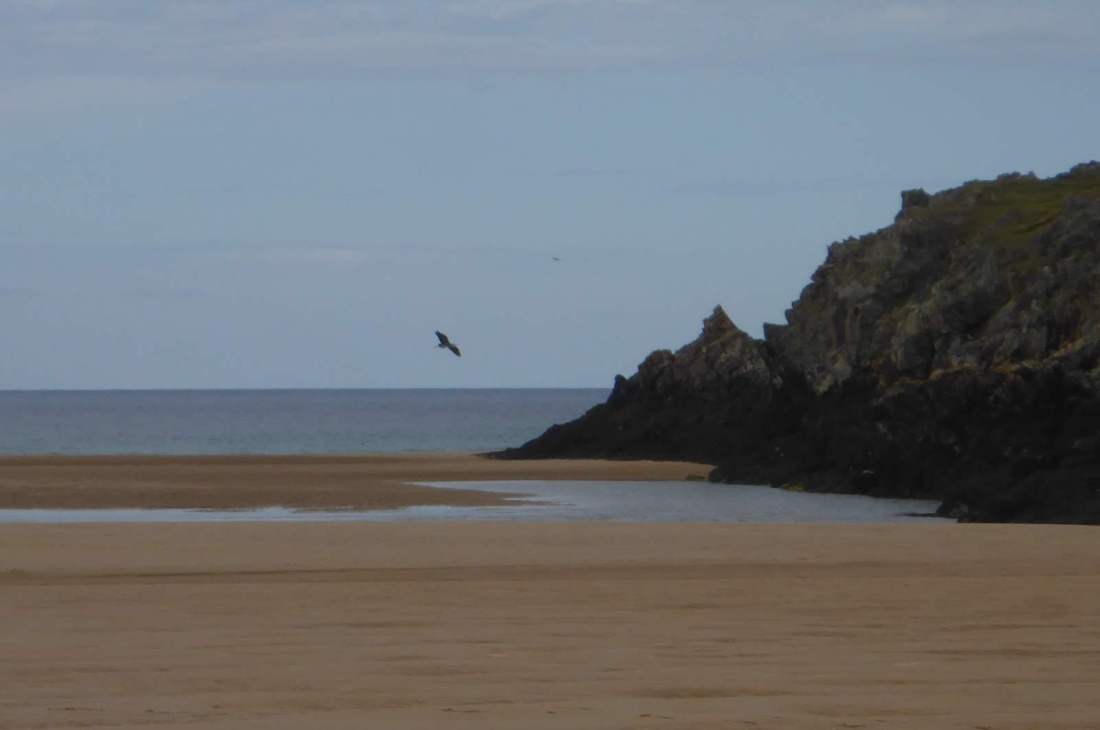
There are few sheltered anchorages on the north coast of Scotland – we selected Rabbit Island, Kyle of Tongue for an overnight stop, leaving a day’s sail to reach the Orkneys, 40 nm away. Getting into Scapa Flow requires care in a boat like Ventata as the tide in the sound of Hoy runs so fast.  We set out at 6am to catch this tide, which was due to turn the right direction at 6pm.  It was obvious, after a couple of hours, that we weren’t going to make it so, rather than motor, we put back in to the next bay up the coast to wait.  It had a wonderful, clean sandy beach so we pumped up the kayak and rowed ashore for lunch.  We’re pretty sure we sure an eagle flying over it.  Getting back to Ventata was interesting (read “wet”) as there were breakers rolling onto the beach.

Day88 Sea eagle
Probably a sea eagle, seen from the beach at Torrisdale Bay

We revisited our plan for the second Orkneys attempt: The wind was forecast to come to the east and strengthen from late afternoon, and though idyllic, the anchorage was too tippy for a good night’s sleep.  We decided on a night crossing and, after much debate, a 9pm departure, on the basis that if we made an average speed of:

·       4 knots (normal in light wind), and didn’t need to tack, we would arrive (at the sound) at 7am

·       5 knots (easily do-able in decent wind in the right direction) we get there at 5am and wait

·       6 knots (possible given the forecast) we would be even earlier, and would carry on further, with an alternative anchoring option in the northern part of the islands

·       3 knots (has been known) we would need to motor otherwise we miss the window

But, if the wind moves from the east to the north east and we needed to tack, the 40 mile journey becomes 60. We would still be OK if we made 5 knots, any slower and we may need to motor (see above about Helen’s view on this).

At 9pm we departed to a beautiful sunset.  Stars came out – always useful as it is horrible steering with nothing to get your bearings.  We reefed at about 23:30; it was still just light, we are so far north.  Many shooting stars (Perseid shower).  The sea was flat and the wind smooth and strong; we put in the other reef later on.  Overall a glorious sail.  We needed to put in a couple of tacks but arrived off the Sound of Hoy at about 7am.  We took the main down as we approached the narrows, and sailed through sideways at over 10 knots, just motoring the last mile or so to berth in Stromness.

Day89 Cold Morning
Dawn at sea – colder than it might look!

Since then we have had a great week being tourists.  Unfolded the folding bikes, bought an explorer bus pass and have been touring the sights: Neolithic settlements, WW1/2 defences for Scapa Flow, Old Man of Hoy.  An unexpected highlight was the RSPB eagle watch station – they have been watching the first sea eagle chick to hatch here for 140 years, and we were lucky because, although it has just fledged, it still returns to the nest site and happened to be there when we passed by.  They say “chick” but it is absolutely huge!

Day93 Ring of Brodgar
Ring of Brodgar
Day93 Busy road
Staff at Skara Brae warned us about the busy road on our route to Brodgar.  They obviously haven’t been to Bracknell…


Sore fingers and toes

Our return to the Scottish mainland was to Loch Ewe. The entry is marked by numerous look out stations and disused gun turrets, having been the main despatch point for the Arctic convoys in WWII; it is still a NATO staging post.

In spite of this status, and of being within 5 miles of the Loch Ewe VHF transmitter, at our anchorage we were unable to pick up the coastguard weather reports and there was no mobile signal or internet (though wherever we go ashore we seem to almost get run down by a BT Open Reach van so maybe they are working on that). In the end we had to go to the Inverewe garden café for lunch and wifi, just to get a weather forecast. Not a problem, as Inverewe gardens, was our reason for anchoring here: an improbable oasis of plant-life shelters behind a cover of scots pine planted to provide protection from the elements. They were established in 1862 by Osgood MacKenzie and continued throughout his lifetime and afterwards for 30 years by his daughter, before being handed to the Scottish National Trust.

The damp weather did not improve, and we spent most of the following day re-stitching the UV strip onto the genoa.  Most of the stitching on the foot and a good number of places on the leech needed attention.  With the tough material, this became more and more painful on the fingers, even though we were simply putting new thread through the existing stitch holes.  With both of us working on it, it took about 8 hours!

Day83 Seal in Lochinver
Meeting the locals at Lochinver

Moving north, with dwindling supplies and depleted batteries after days at anchor, we came into Lochinver, which sits under the shadow of the rather peculiar shaped mountain of Suilven.  Walking up it was one of the most spectacular hill walks we have ever done.  In rare, cloud-free moments the top is visible from the pontoon where we were moored, so no messing about with buses or bikes to get to the start.  There’s a pleasant 5 mile walk in, gradually gaining a couple of hundred metres of height, then it’s a mile straight up the side of the hill to the summit at about 800m and back down (somewhat footsore)the same way.  There were some “airy” moments crossing small ridges with big drops on both sides, and a few bits of scrambling but, miraculously, the conditions were perfect: dry, clear and with a well-constructed path (unlike some of our previous walks)that avoid wading the bog and unstable slopes. The views from the top quarter are amazing, the beautiful landscape of north west Scotland is laid out, mountains surrounded by rivers and lochans and far out sea.


Heatwave, what heatwave?

This post has been rather delayed by lack of internet signal in the remote corners of Scotland!  No chance of uploading an update or downloading the Archers omnibus.  In places there has been no DAB or FM radio, and for the last couple of days we have struggled to get even the Stornoway coastguard weather reports.

The Scottish scenery is amazing.  Dramatic shorelines with waterfalls overflowing from the cliffs, rugged countryside with high mountains above, and amazing waterways in between to explore.  Pairs of puffin, groups of guillemot everywhere; gannet common both individually and in small formations.  No sign of the local eagles but Helen thought she saw a whale near Canna.  ‘Though it was gone before you know it and Alex wonders if she really saw anything at all…

The views are so good it’s a shame you can so rarely see them.  This morning the cloud is barely above the mast.  For more than half of our time here it has been raining and the boat is full of wet sailing and walking gear.

After leaving John on the fast ferry out of Jura, we drifted miserably up the sound of Jura and picked our way into a rocky inlet in zero visibility.  The following day was fine and we walked 5 miles across the peninsula to Tayvallich for milk and a newspaper.  (Later decided that the milk was too heavy considering the 5 miles back.)  From there, we headed north, spending a rare, sunny evening in a glorious anchorage north of Kerrera, perfectly sheltered and surrounded by mountains.

Day69 Paps of Jura
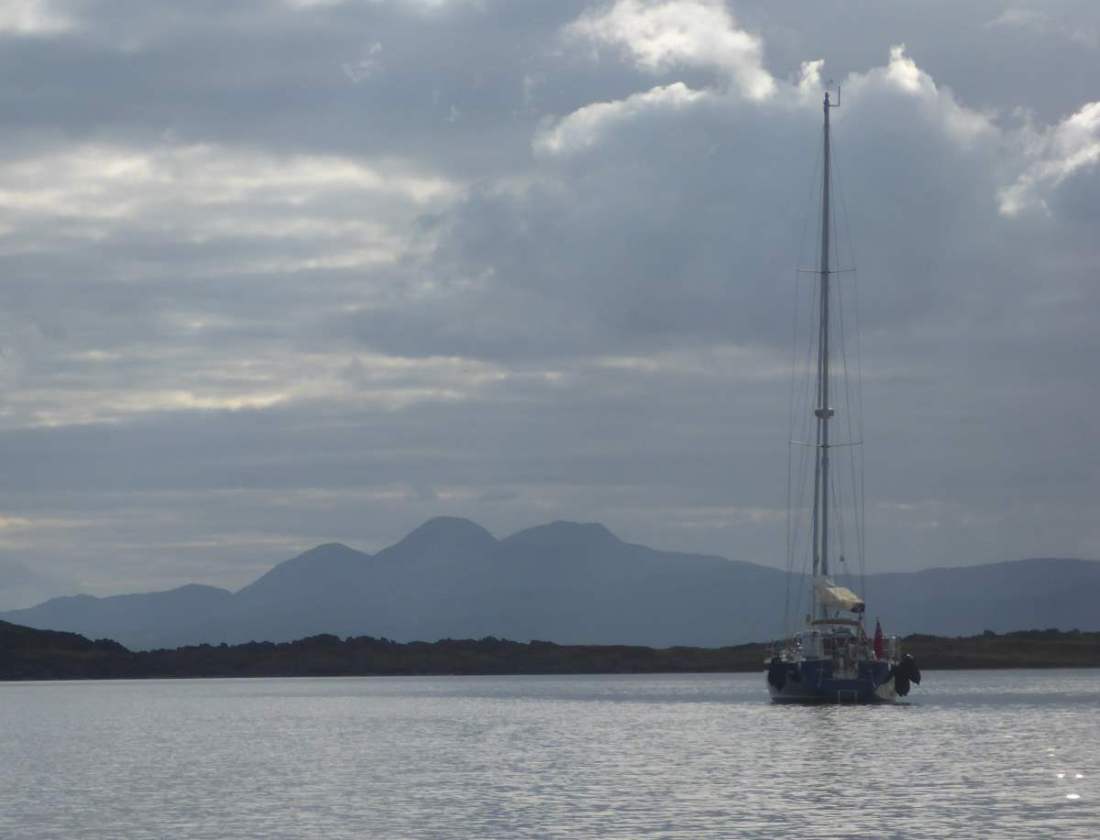
At anchor, half-way up the Sound of Jura, Paps of Jura in the background

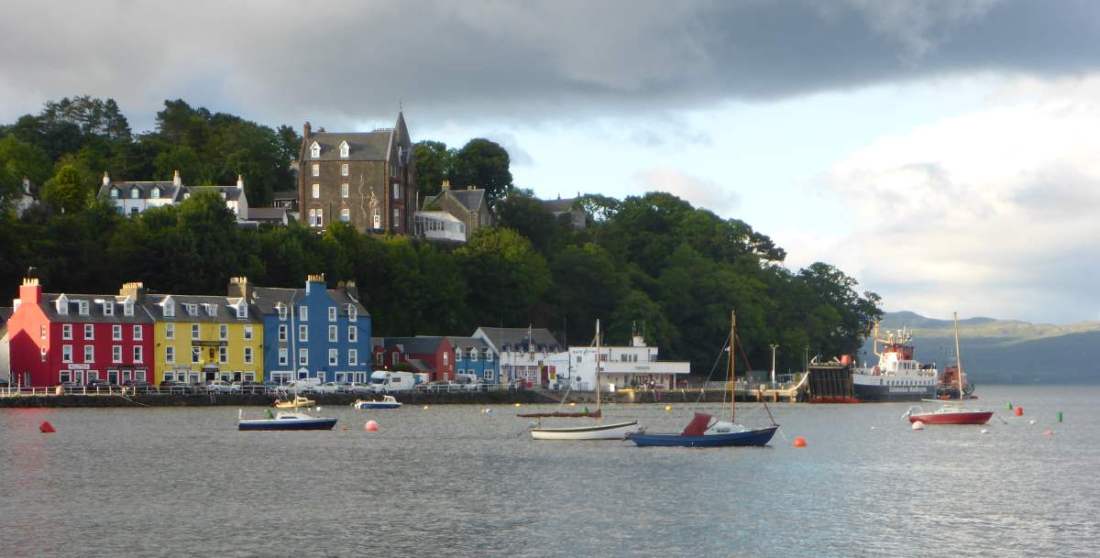
Then north west through squally conditions up the sound of Mull.  No wombles in Tobermory but they have a great aquarium where the exhibits are temporary visitors that are returned to the sea after a few weeks on view.  We each bought new trainers and, having spent too long over this, sprinted in them 2 miles through the woods to the Mull theatre, where 3 local actors were putting on a short play.  Didn’t recognise the star with previous credits in Cracker and Holby City but the play was entertaining, and was followed by food, wine and a Q&A session with the cast.  The main character was offered repeated opportunities to thieve a life-changing sum from a faceless organisation and elevate his miserable existence to a higher plane, consistent with his peers.  What would you do?

Day72 Tobermory
Tobermory

As we turned north from Tobermory, for an overnight stop off Canna, on our-route to Skye, we noted the other boats all went south!  Perhaps they were not keen on the F8 (gusting F9) that picked up.  We have become practiced at shortening sail quickly – it doesn’t seem to matter what the forecast is, big hills combined with big clouds seems prone to give you 45 knot gusts.  It is also easy to make mistakes in these conditions.  

Skye offered excellent mooring facilities at Carbost, at the head of Loch Harport and the location of the Talisker distillery. Our arrival was marked by driving rain and head winds that made it difficult to see the mooring buoys as we approached. Determined to see some the island we had a walk into Glen Brittle forest, draining the water from our shoes every few km. We tried a drying out spot in the distillery on the way back, but declined the option to pay more for a bottle of Talisker than at the Supermarket at home.


We left Skye in thick mist with visibility down to a few hundred yards.  As we tacked out of the loch into a 25 knot headwind, rocks appearing from the mist on either side, a bodged tack resulted in a riding turn on the winch and a rather nasty game of free the sheet.  Incidents such as this, and accidentally unfurling rather than furling the jib, have taken their toll on the sail.  We thought the foot was coming unstitched but were relieved to find it is only the protective UV strip that has come adrift. It needs re-stitching before we move on – a good job for a rainy day, and there seems to be plenty of those!