Closing the loop

One of the challenges of the trip has been the continual element of surprise – however long you spend scrutinising the weather forecasts, you can never be sure of the conditions you will find until you actually get out there.  Expecting a cold and miserable sail back from Harwich, we instead found perfect conditions – a smooth 15 knot breeze in a favourable direction, flat water and a cool but sunny day.  In fact, the ideal day for a sail.  Ventata romped along at 7 knots and we flew past the wind array, remembering previous trips where we had inched painfully past each row of turbines.
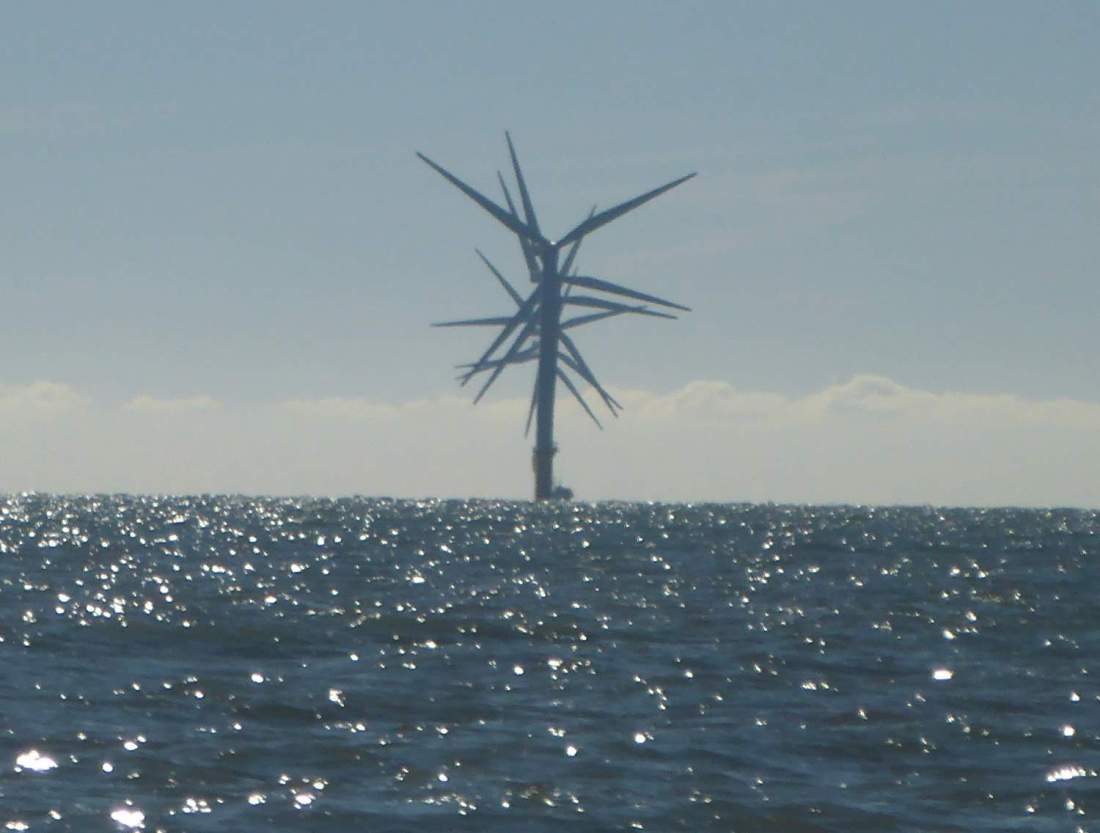
Day132 Wind tubines
Offshore wind

With spring tides, there was plenty of water by mid-morning to cross the Wallet, a narrow gap, 15 miles offshore, in the barely-submerged sandbank that extends all the way past the wind array.  (Last year we got our timings wrong for this gap and, being too impatient to sit around in lumpy conditions waiting for the tide to rise, our planned holiday in the river Blackwater became an unplanned holiday in the river Crouch instead.)  We celebrated with morning tea and chocolate brioche, and delightedly ticked off each of the familiar buoys through the sands: Swin Spitway, Inner Whittaker, NE Maplin, Bell Maplin, Blacktail Spit, Sea Reach #1 among others.

Rogues gallery

We reached the start of the Medway approach channel by early afternoon just as the wind died.  We persevered for a bit under sail, but as the tide strengthened we were not in a good position to sail into the Medway with millions of tons of water trying to get out of the narrow channel at the same time.  [Some interesting features of spring tides: either the moon rises just as the sun sets (full moon, good as you can see well at night) or the moon rises as the sun rises (new moon, good for stars at night but if it’s cloudy you won’t be able to see a thing).  The earth, sun and moon are aligned in both cases which sends a lot of water sloshing around.  On the east coast, high water at springs is always close to midday; this timing is also influenced by the effect of the land on the tidal flow.]

However, by then we had done it!  On Day 132 of our trip, we crossed our outward track and completed our circumnavigation.  We’ll post some stats relating to the trip a bit later.  We did a proper harbour stow of the mainsail, flaking each of the folds down neatly and motored up to Stangate Creek where we dropped our anchor for the last time and sat back to enjoy the evening sun.
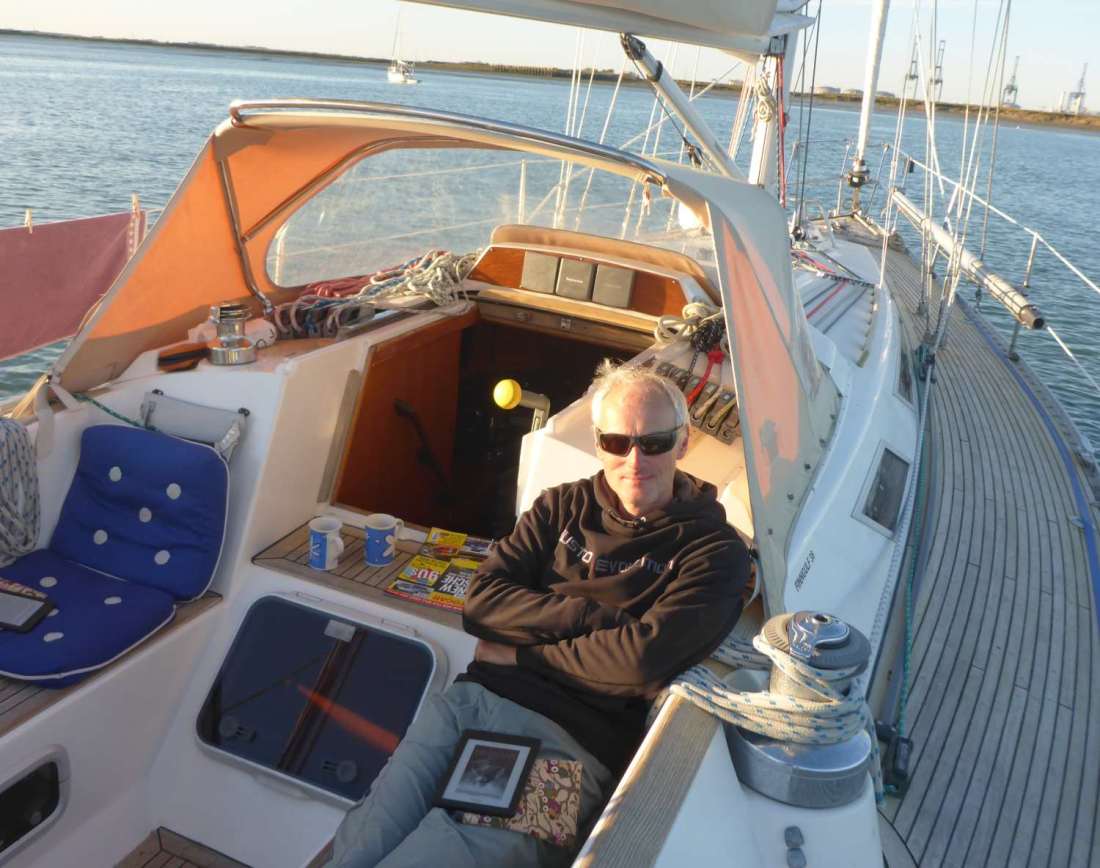
Day132 Relaxing at anchor
Relaxing at anchor after a surprisingly pleasant and easy day
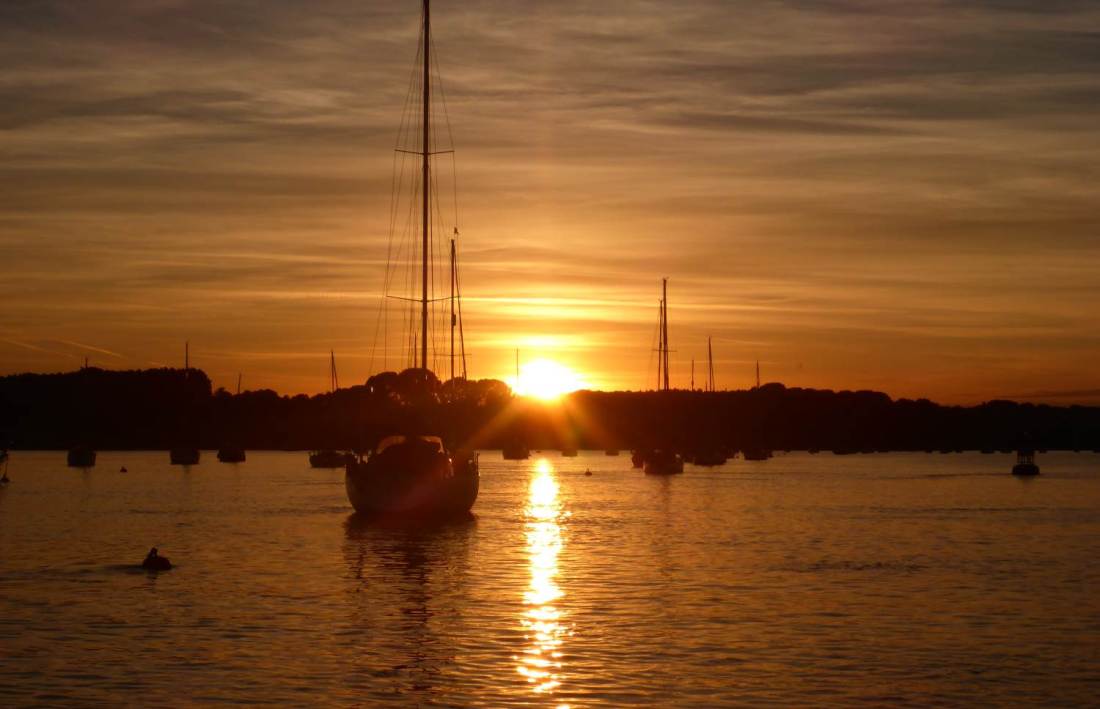
Day132 Red sky at Stangate
Sunset at Stangate

The following day we motored in a flat calm back to the marina.  One thing we haven’t missed about the east coast is the mud.  Good holding, but sand has held us perfectly well elsewhere, and it is oh so nice when the anchor comes up clean rather than bringing 10 kilos of clay-like gloop up with it.  As it was, we got away quite lightly this time.  However, after 132 days of working perfectly, and a single night in the Medway, our speed sensor stopped working, most likely because some little critter has taken up residence and is preventing the small paddlewheel from turning.  Another thing for the maintenance programme.  But first, we will have to face real life again…

Day133 Somewhat muddy anchor
Somewhat muddy anchor – could have been a lot worse…

The devil you know

Yarmouth turned out to be very good value as we didn’t find anyone to pay for our stay.  We figured the harbour master was based elsewhere and more concerned with the sizeable volume of commercial activity than the odd yacht.  As there were no facilities provided other than the wall to tie up to, this seemed fair.  Showers and electricity we can live without (Alex under protest), but rubbish disposal would have been useful.

We enjoyed the crazy golf (Alex won again) and the E.ON visitor centre.  It was rather surreal sitting in the E.ON cabin on the sunny, sandy beach and watching the seals and wind turbines on the sandbank that we had sailed towards for hours during a wild night.  Departing Great Yarmouth at 5:30 am we had another nervy moment as we let go the warps and the fishing boat moored downstream leapt towards us…

Day122 Felixstowe cranes
Back on home territory at Felixstowe
Day124 Sunset while moored on the river Orwell
Sunset while moored on the river Orwell

There probably aren’t many people that get emotional about the sight of the cranes at Felixstowe.  But for us, they were the first familiar landmark since leaving Dartmouth more than 3 months ago.  We are back on home territory at last.  However hazardous the shifting sandbanks fanning out from the Thames estuary, we know our way through them and finally feel close to home.  However, you can see those cranes from 15 miles away and, tacking into a headwind wind, it seemed to take forever to close with the river.  Many more yachts about – we spotted more in one day than the total since Tobermory.  Where there are 2 or more yachts together, there are opportunities to race, which livened up the last part of the journey and had us concentrating better on sail trim.

It is just as well the river Orwell is so pretty, as we have been stuck here for a week with strong wind.  The river is sheltered, lined with trees and low farmland and home to hordes of wading birds.  We have moored at 3 separate buoys, stayed overnight in the centre of Ipswich while Stuart and Cathy came to dinner and have now been in Woolverstone marina for several days.  We twice tried to leave: the first time we only got as far as Shotley point, the second time we were a bit more determined and tacked our way 5 miles outside the harbour before deciding that doing this for another 50 miles was not going to be a runner.  We have been enjoying our time though, improving our average step count for the month with walks along the coast, across fields, through proper woodland (more interesting than the pine forests at home), around a reservoir and taking in cake shops in the afternoons.  We are at ‘peak blackberry’ and it has been just about warm enough to wear shorts for walking.  We went to the cinema again too.

Today it is cold and wet so we have the cabin heater on, but it does look as if the wind might be OK for heading home tomorrow…

Trouble getting up in the morning

Leaving Hartlepool, we weren’t particularly looking forward to the next passage.  We knew we would have limited options for shelter until reaching Great Yarmouth: the anchorages available were all more-or-less exposed to wind and swell and the harbours (those that had sufficient water at all) were accessible only close to high water.  The forecast showed strong wind interspersed with flat calm and of course the nights have become longer and the temperatures colder.  It all added up to a general sense of foreboding.

We stayed in Hartlepool an extra day to allow one set of strong winds to blow through and left our berth at 5 am to catch the high water.  On the way in to the marina, on a falling tide, we had been a little lucky to arrive 2 hours before the time the marina staff told us would be the latest we could enter.  If we had left it any later we would have grounded in the entrance.  We suspect that not all the staff understand the calculation of the depth of water needed for safe passage given the charted height of mud in the entrance and the depth of your keel.  (Not that this is any more complicated than it sounds.)

We had a good run during the day and anchored overnight in Filey Bay which, though pretty exposed, was not as bad as some (i.e. we were able to get a bit of sleep).  Then another early start to make sure of rounding Flamborough Head before the tide turned at 9 am.  We were blessed with good wind and made decent progress with our tour of North Sea energy producing facilities: oil and gas platforms, and many wind farms do at least give you something to look at, as well as being useful navigation marks.

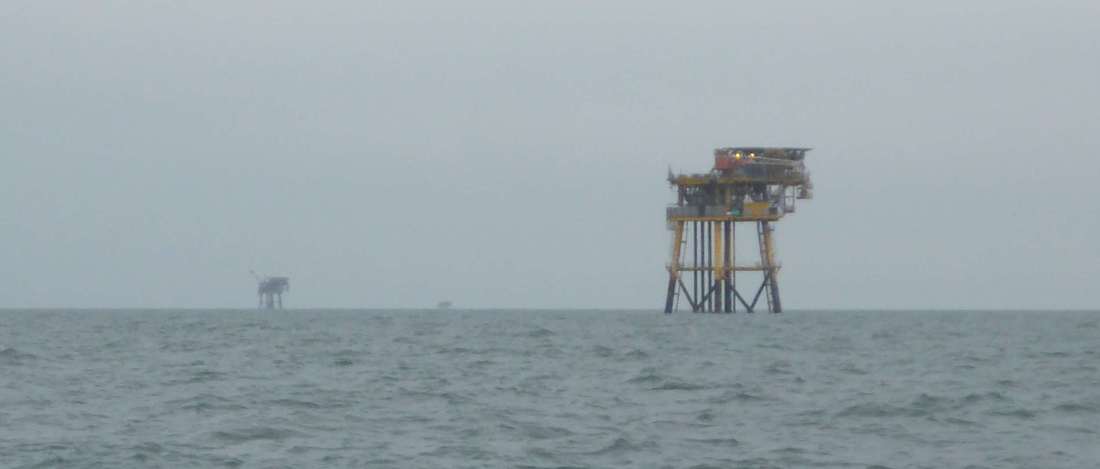
Day119 Amethyst gas field
Amethyst gas field, 20 miles west of the Humber

At 7 pm the wind dropped and we found ourselves motionless, equidistant from the Humber and north Norfolk, 30 miles from land in either direction, with not much in sight and night about to fall.  It seemed a good time for dinner as we flopped around, drifting on the tide for two miles whilst we ate.  A group of harbour seals came out to see what we were up to.  But within an hour the wind picked up from a different direction and the seals patiently sat at the stern watching, in apparent amusement, our attempts to launch the cruising chute.  Night fell, and we had the most amazing glimpse of the Milky Way through a brief gap in the clouds.  We started to think we might get away with an easy passage.

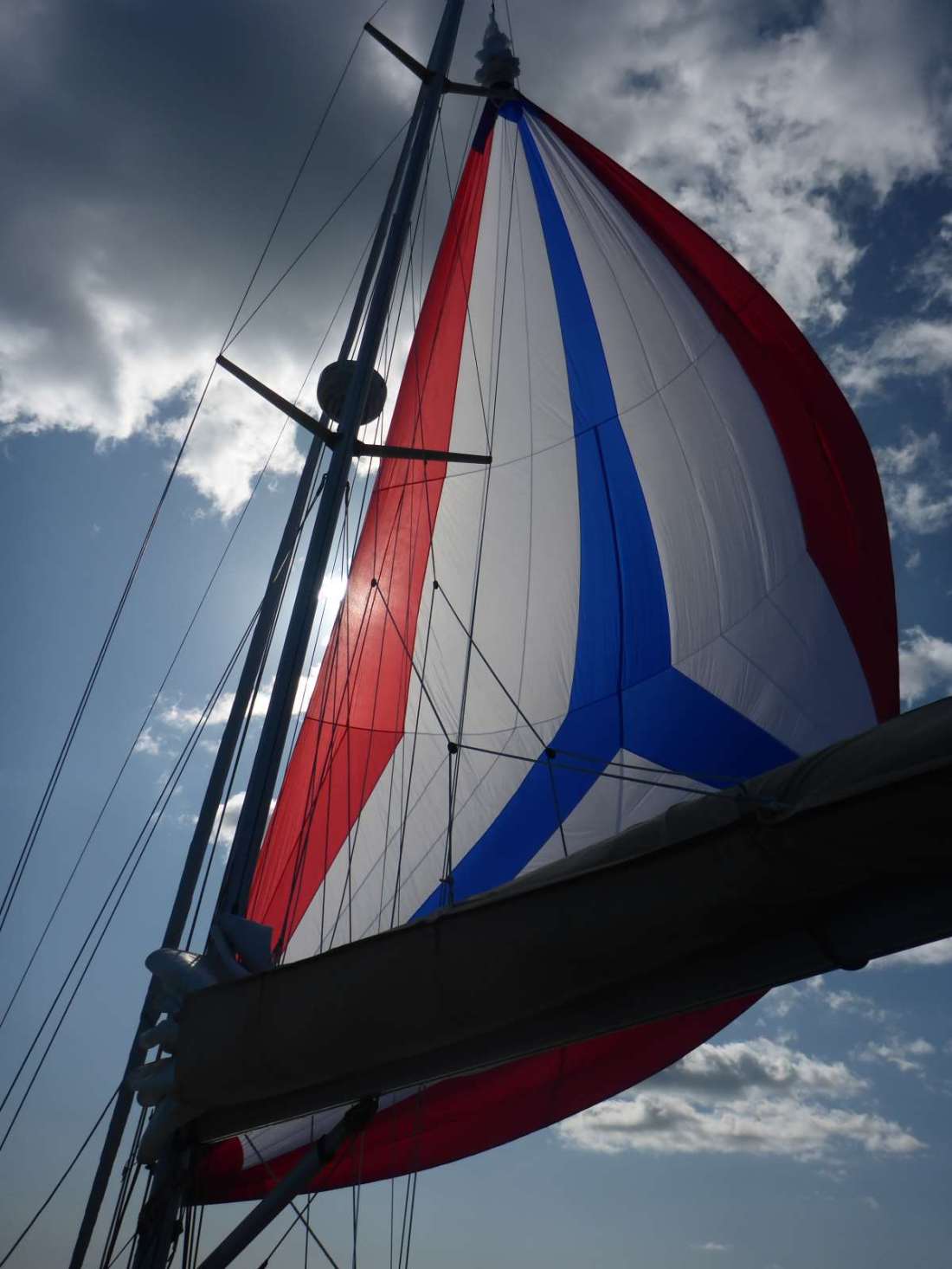
Day114 Cruising chute
Sailing with just the cruising chute

Spoke too soon… as we closed on the coast of north Norfolk, shipping seemed to converge on us from all sides.  At one point there were 7 boats coming at us from 3 directions, at speeds up to 14 knots.  No idea if any of them had seen us.  Eeek!  Brief evasive action needed: as a gap opened up between the traffic, we scuttled into it before resuming our course.

Things didn’t quieten down even when we reached the channel inside the sandbanks that runs down the coast.  We expected to have this to ourselves but some surprisingly large traffic was tramping up and down it, added to which the wind suddenly picked up to fearsome levels.  Helen was woken from a comfortable snooze on the floor of the saloon by sliding from one side of it to the other.  We were still under full sail.  Charging downwind in a narrow channel, in poor visibility, with lots of other boats about was not Helen’s ideal scenario, although Alex thought it was making life more interesting.  Brought the mainsail down completely, never mind reefing, plenty of power with just the jib.  For once we were grateful for the adverse tide that would slow our progress towards the tricky narrow section ahead until daylight.

Day119 Night sailing 1
Sailing at night…
Day119 Night sailing 3
…this is about as much as you can normally see – just instruments and red/green nav lights

The entrance to the Yare is straightforward and, as the river is narrow and the tidal flows strong, all movements are coordinated by Port Control through the VHF.  No complicated marina to negotiate this time, just a matter of tying up to the wall of the town quay.  This is a manoeuvre we are not very familiar with so we were employing the best traditions of “making it up as we went along”.  Alex didn’t particularly enjoy bringing the boat alongside the wall, as the strong current was rapidly dragging the boat up river towards the Haven bridge.  Holding the boat alongside while putting out lines was rather stressful, particularly as (for some reason) the current was pushing us away from the wall.  The investment in those large fenders, and months of aggravation of getting them all in and out of the cockpit locker every time we berth suddenly repaid with interest.  Organising the warps to allow for a 2-3m of rise-and-fall took a fair bit of experimentation too.  Still, we were eventually tied up snugly and delighted to find out from Google maps that there was a crazy golf course within half a mile.

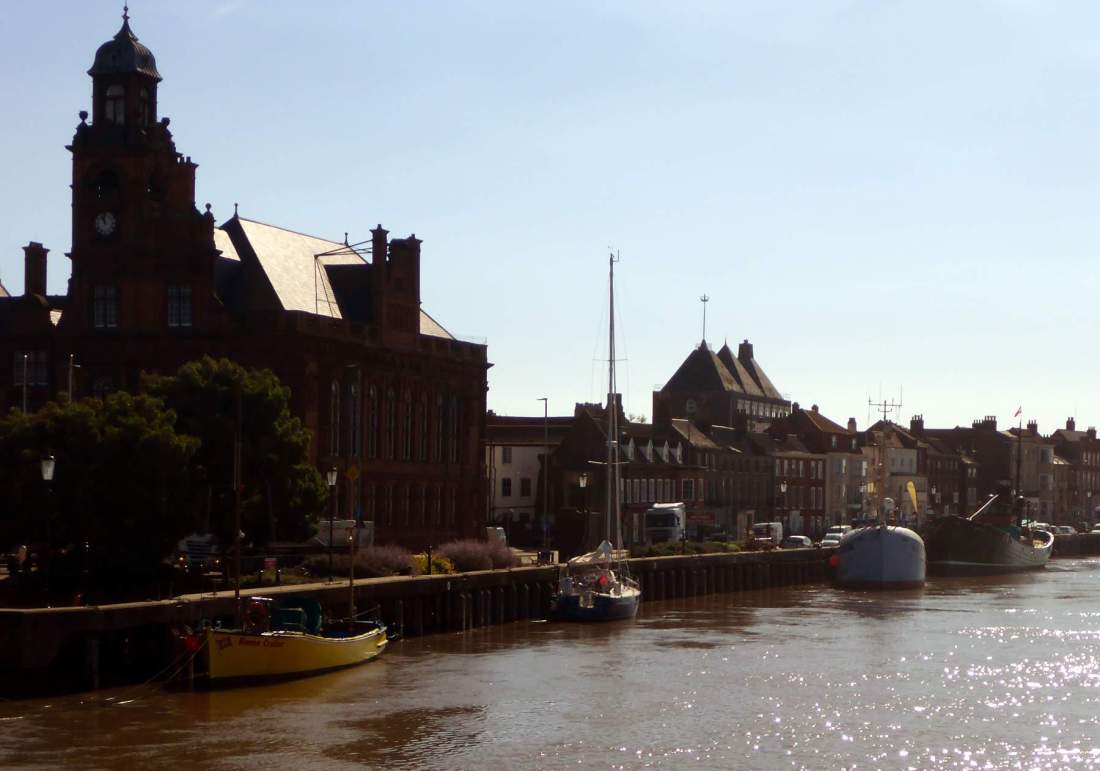
Day121 Moored at Great Yarmouth town quay
Moored at last alongside the wall at Great Yarmouth town quay.  The river looks tame but the current is strong…

Plusses and minuses on our return to England

Lindesfarne provides a sheltered anchorage between Eyemouth and Newcastle, in the shadow of Holy Island and adjacent to an enormous colony of grey seals.  The seals kept up a continuous sighing, moaning sound for the duration of our visit, which was rather eerie.  At night we could hear their noisy snuffling close to the boat, and were disturbed by one of them swimming into the rudder at midnight, giving us a real clunk.

On a sunny and blustery day we kayaked ashore to walk around the island, alternately scrambling up and down the sand dunes and sitting on the shoreline to watch the world go by.  Despite being well aware of the tidal nature of the island, we were almost caught out on the trip back.  We were distracted by the dozen or so seals that came out to investigate us and didn’t notice how far down-tide we were being carried in the kayak.  A furious paddle was required to regain the distance to Ventata, the seals making light work of keeping up with us.  Thought they might have offered us a tow!  However, some of them were pretty big so on balance we were happy they didn’t come any closer.  Wikipedia suggests they live up to 35 years and adults weigh 200-300kg.  (Note to check that rudder when we get back.)

The next anchorage, at Amble, was decidedly less comfortable.  We had decided not to go in to the marina so anchored off the sandy beach and rolled around for the following 8 hours in the persistent swell.  We watched a yacht approach the marina, fenders ready, and change its mind after seeing us – it went slightly further up the coast to anchor.  We hope they didn’t blame us for a rather sleepless night…

Our arrival at Newcastle coincided with preparations for the Great North Run and the last few days of the Great Exhibition of the North. We had a pleasant day wandering around the city centre and admiring the many bridges over the Tyne.  However, the Baltic art exhibition was, oh dear, just dreadful (to our taste anyway).  The building redeemed itself with a mirror at the bottom and top of the stairwell that created an illusion of infinite height and depth – vertigo-inducing even when on the ground floor.

Royal Quays marina had the most luxurious facilities we have experienced since Ireland.  We had expected Port Edgar marina, near Edinburgh, to be similar but it currently resembles a building site, with a half-mile walk to the facilities across an unlit assault course.  However, whereas Port Edgar sits in the quaint and attractive village of Queensferry, Royal Quays has all the advantages supplied by North Shields.  In spite of this,  our stay at Royal Quays was so pleasant that we had a bit of a motivation failure when it came to leaving.  The tide times dictated an early start and we had intended to get through the loch and lie on the waiting pontoon pending a 2am departure.  But when it came to time to move, we agreed we just couldn’t be bothered.  We had a bath instead, and a cup of tea in the marina bar.

With a later departure, we didn’t have time to get to Whitby before the water ebbed and we headed into Hartlepool instead.  This has proved a mixed blessing.  On the plus side, there is a cinema within sight of the marina, so we got to see Tom Cruise playing Tom Cruise in Mission Impossible Fallout, as well as HMS Trincomalee, a wonderfully restored 48 gun Royal Naval frigate, on Helen’s birthday.  It was less fun trying to follow the route of the English Coastal Path: the path was disjointed, badly signposted and covered in dog poo.  Too much high security fencing for an urban area, buildings near the football club have protective screening over their windows and there is dog poo everywhere: this is “not an entirely harmonious community”, as Alex put it.  Did I mention the dog poo?  A shame, as the woodland and rolling farmland were rather pretty once we got past the “keep out” signs.


Last days in Scotland

Many years ago, when driving home from Italy, we decided to drop in to Munich because Alex wanted to visit the BMW museum.  We were surprised by how busy the campsite was and it turned out our visit just happened to coincide with Oktoberfest.  With a similar lack of planning, after catching the rather good bus service between Port Edgar and Edinburgh, we found we had hit Edinburgh on the last day of the fringe festival.  On impulse (because it appealed to Helen) we bought tickets for the acclaimed Soweto Gospel Choir and later spent 30 min in an orderly queue in the rain to get in to the stunning Assembly Hall.  Good fun, and an opportunity to sit down for a few minutes.  Helen in particular was rather low in energy.  However, an oversized cake afterwards in lieu of proper food did not seem to help matters.

We were both despondent when leaving Port Edgar, feeling we had not done the place justice after all the effort made to get there.  However, it was easy sailing downwind, to a pleasant anchorage off North Berwick.  This is at the entrance of the Firth of Forth, under the shadow of Berwick Law, which Alex recalled climbing when on holiday as a child and where Helen, with surprise, caught a large mackerel.

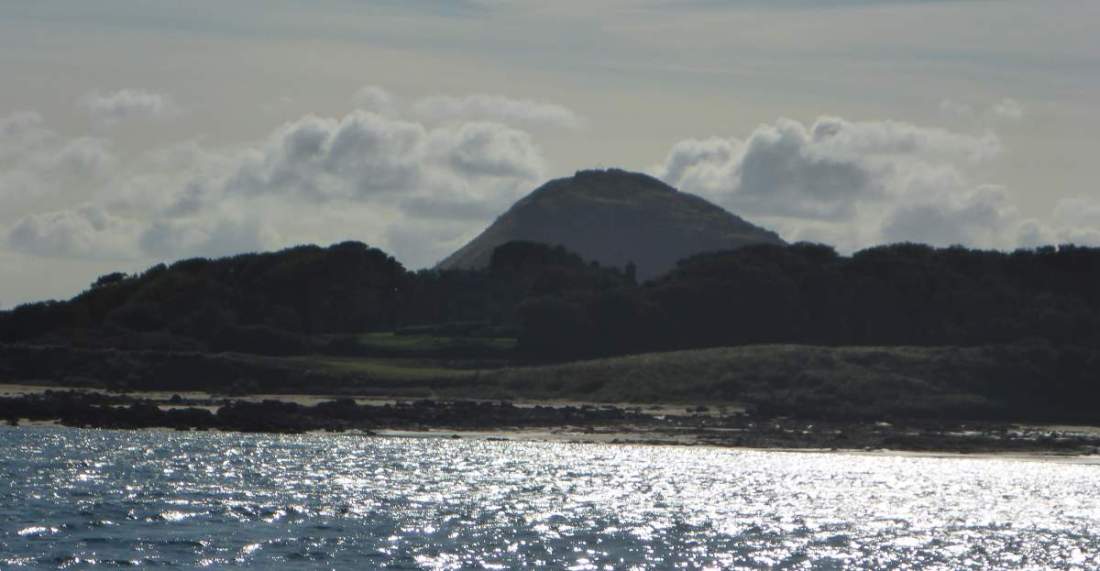
Day105 Berwick Law
Berwick Law

Helen has been enjoying fishing more and more.  Initially there were a few qualms – if we caught a fish there would be the messy business of dealing with it – but our confidence has grown as our experience has shown we can spend hours with the rod over the side without any danger of hooking anything.  Still, unless you are vegetarian, it seems right to face the experience of catching and killing your own food.  The mackerel tasted great, after gutting, filleting and pan-frying.

For weeks we have been watching nature at work in all its blood and gore, and judging by the size of the gannet colony we passed the following day, there can’t be a local shortage of mackerel.  Bass rock, sitting in the entrance to the Firth, is absolutely teeming with them. From a distance it appeared as if it was snowing over the rock, and for 15 miles up the coast we passed raiding parties of up to a dozen birds hunting together.

Our destination, Eyemouth, had a narrow rock-strewn entrance leading to a pontoon right in the centre of town.  Not quite enough water for us, especially at spring tides, but the bottom was soft and Ventata wiggled her keel half a metre into the mud each low water.  The pontoon was dead on the route of the coastal path which was good for walking, if not for privacy.  A well-defined, rolling path took us on wonderful cliff walk to St Abbs Head for lunch, and also provided the first blackberries of the year.  And, on departure at about 7am we had absolutely the best send off from Scotland that you can imagine, with a pod of dolphins jumping along our bows as we exited the bay.