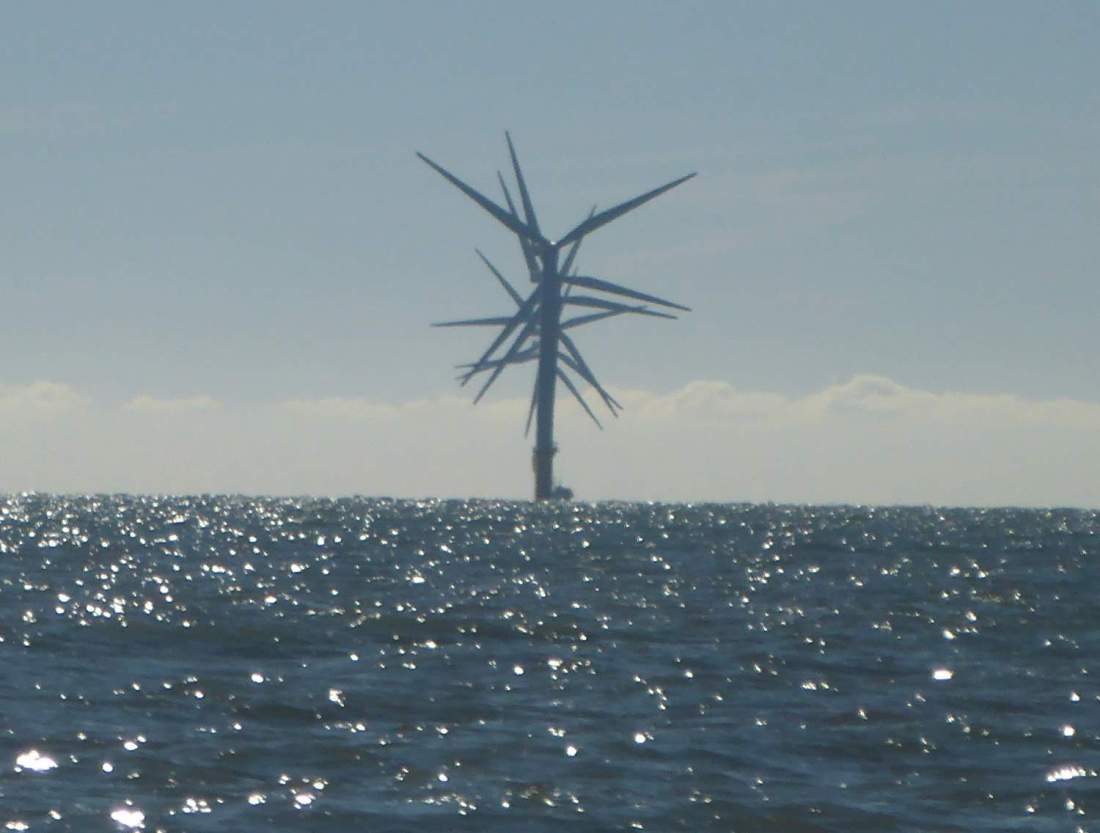
One of the challenges of the trip has been the continual element of surprise – however long you spend scrutinising the weather forecasts, you can never be sure of the conditions you will find until you actually get out there. Expecting a cold and miserable sail back from Harwich, we instead found perfect conditions – a smooth 15 knot breeze in a favourable direction, flat water and a cool but sunny day. In fact, the ideal day for a sail. Ventata romped along at 7 knots and we flew past the wind array, remembering previous trips where we had inched painfully past each row of turbines.
Offshore wind
With spring tides, there was plenty of water by mid-morning to cross the Wallet, a narrow gap, 15 miles offshore, in the barely-submerged sandbank that extends all the way past the wind array. (Last year we got our timings wrong for this gap and, being too impatient to sit around in lumpy conditions waiting for the tide to rise, our planned holiday in the river Blackwater became an unplanned holiday in the river Crouch instead.) We celebrated with morning tea and chocolate brioche, and delightedly ticked off each of the familiar buoys through the sands: Swin Spitway, Inner Whittaker, NE Maplin, Bell Maplin, Blacktail Spit, Sea Reach #1 among others.
Maplin starboard hand buoy
Sea reach channel marker
Stangate Spit east cardinal
Medway isolated danger mark
Rogues gallery
We reached the start of the Medway approach channel by early afternoon just as the wind died. We persevered for a bit under sail, but as the tide strengthened we were not in a good position to sail into the Medway with millions of tons of water trying to get out of the narrow channel at the same time. [Some interesting features of spring tides: either the moon rises just as the sun sets (full moon, good as you can see well at night) or the moon rises as the sun rises (new moon, good for stars at night but if it’s cloudy you won’t be able to see a thing). The earth, sun and moon are aligned in both cases which sends a lot of water sloshing around. On the east coast, high water at springs is always close to midday; this timing is also influenced by the effect of the land on the tidal flow.]
However, by then we had done it! On Day 132 of our trip, we crossed our outward track and completed our circumnavigation. We’ll post some stats relating to the trip a bit later. We did a proper harbour stow of the mainsail, flaking each of the folds down neatly and motored up to Stangate Creek where we dropped our anchor for the last time and sat back to enjoy the evening sun.
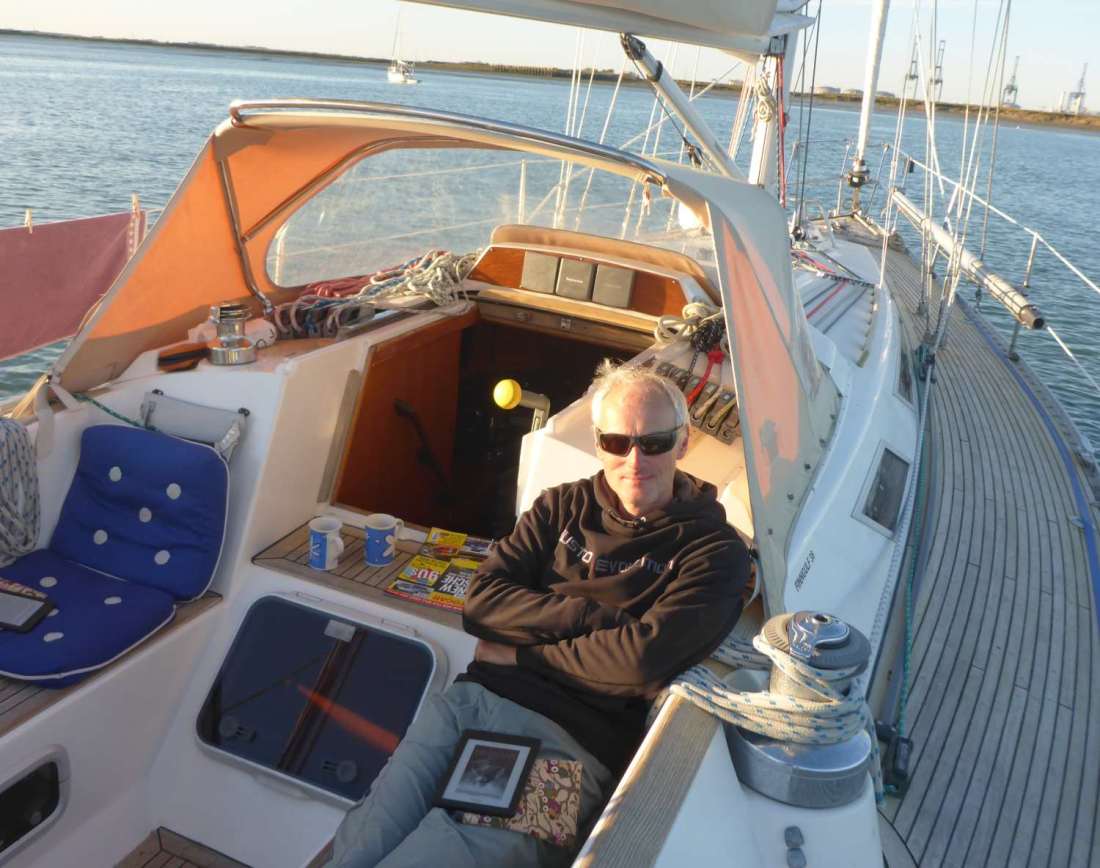
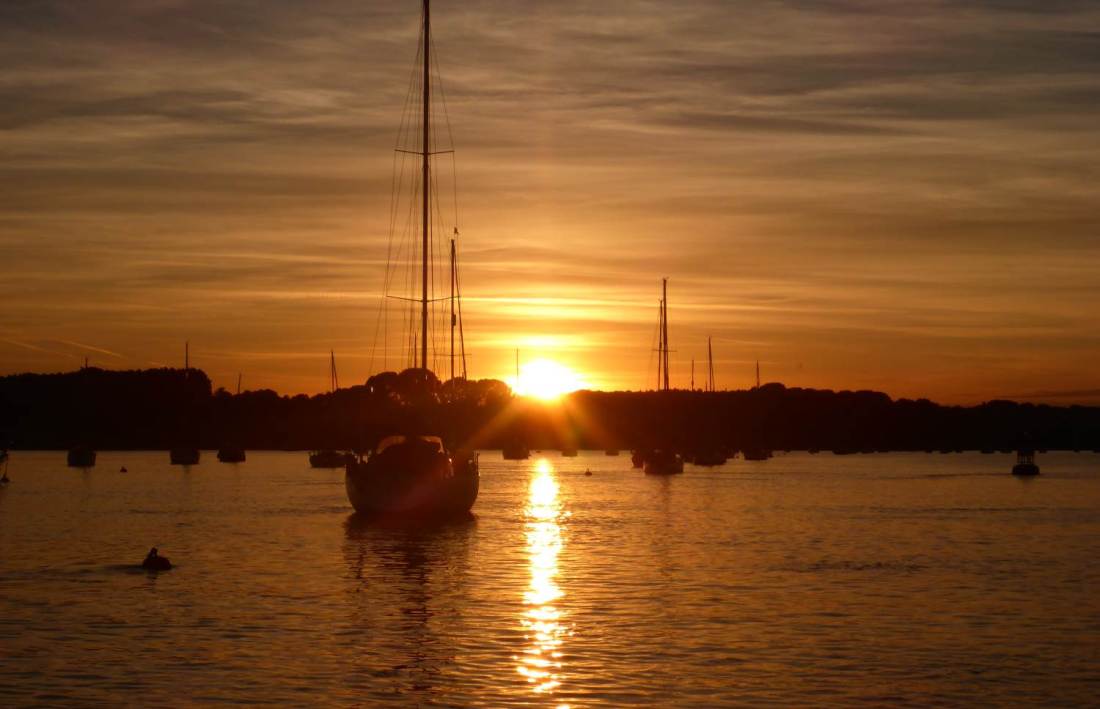
Relaxing at anchor after a surprisingly pleasant and easy daySunset at Stangate
The following day we motored in a flat calm back to the marina. One thing we haven’t missed about the east coast is the mud. Good holding, but sand has held us perfectly well elsewhere, and it is oh so nice when the anchor comes up clean rather than bringing 10 kilos of clay-like gloop up with it. As it was, we got away quite lightly this time. However, after 132 days of working perfectly, and a single night in the Medway, our speed sensor stopped working, most likely because some little critter has taken up residence and is preventing the small paddlewheel from turning. Another thing for the maintenance programme. But first, we will have to face real life again…
Somewhat muddy anchor – could have been a lot worse…
Yarmouth turned out to be very good value as we didn’t find anyone to pay for our stay. We figured the harbour master was based elsewhere and more concerned with the sizeable volume of commercial activity than the odd yacht. As there were no facilities provided other than the wall to tie up to, this seemed fair. Showers and electricity we can live without (Alex under protest), but rubbish disposal would have been useful.
We enjoyed the crazy golf (Alex won again) and the E.ON visitor centre. It was rather surreal sitting in the E.ON cabin on the sunny, sandy beach and watching the seals and wind turbines on the sandbank that we had sailed towards for hours during a wild night. Departing Great Yarmouth at 5:30 am we had another nervy moment as we let go the warps and the fishing boat moored downstream leapt towards us…
Back on home territory at FelixstoweSunset while moored on the river Orwell
There probably aren’t many people that get emotional about the sight of the cranes at Felixstowe. But for us, they were the first familiar landmark since leaving Dartmouth more than 3 months ago. We are back on home territory at last. However hazardous the shifting sandbanks fanning out from the Thames estuary, we know our way through them and finally feel close to home. However, you can see those cranes from 15 miles away and, tacking into a headwind wind, it seemed to take forever to close with the river. Many more yachts about – we spotted more in one day than the total since Tobermory. Where there are 2 or more yachts together, there are opportunities to race, which livened up the last part of the journey and had us concentrating better on sail trim.
It is just as well the river Orwell is so pretty, as we have been stuck here for a week with strong wind. The river is sheltered, lined with trees and low farmland and home to hordes of wading birds. We have moored at 3 separate buoys, stayed overnight in the centre of Ipswich while Stuart and Cathy came to dinner and have now been in Woolverstone marina for several days. We twice tried to leave: the first time we only got as far as Shotley point, the second time we were a bit more determined and tacked our way 5 miles outside the harbour before deciding that doing this for another 50 miles was not going to be a runner. We have been enjoying our time though, improving our average step count for the month with walks along the coast, across fields, through proper woodland (more interesting than the pine forests at home), around a reservoir and taking in cake shops in the afternoons. We are at ‘peak blackberry’ and it has been just about warm enough to wear shorts for walking. We went to the cinema again too.
Barges moored at Pin Mill
Says it all…
Woodland walking
Alton water
Today it is cold and wet so we have the cabin heater on, but it does look as if the wind might be OK for heading home tomorrow…
Leaving Hartlepool, we weren’t particularly looking forward to the next passage. We knew we would have limited options for shelter until reaching Great Yarmouth: the anchorages available were all more-or-less exposed to wind and swell and the harbours (those that had sufficient water at all) were accessible only close to high water. The forecast showed strong wind interspersed with flat calm and of course the nights have become longer and the temperatures colder. It all added up to a general sense of foreboding.
We stayed in Hartlepool an extra day to allow one set of strong winds to blow through and left our berth at 5 am to catch the high water. On the way in to the marina, on a falling tide, we had been a little lucky to arrive 2 hours before the time the marina staff told us would be the latest we could enter. If we had left it any later we would have grounded in the entrance. We suspect that not all the staff understand the calculation of the depth of water needed for safe passage given the charted height of mud in the entrance and the depth of your keel. (Not that this is any more complicated than it sounds.)
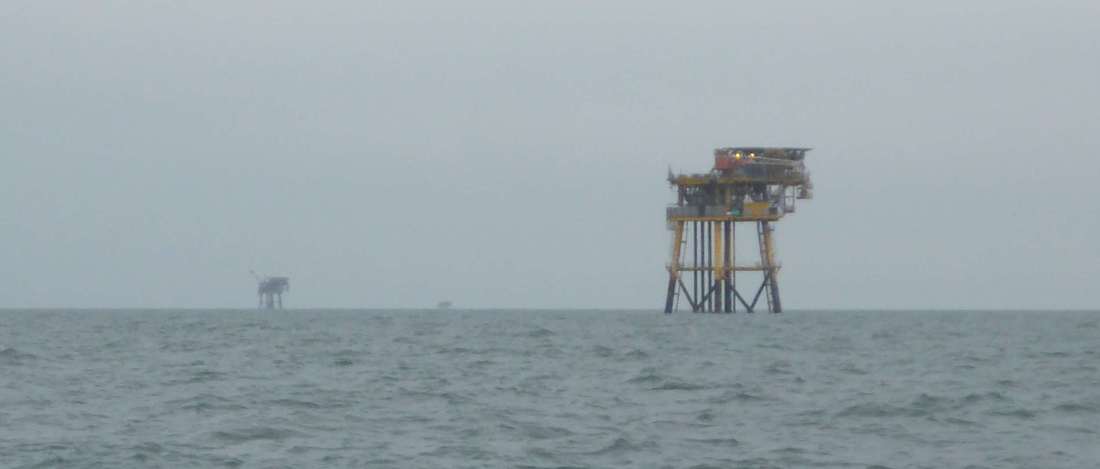
We had a good run during the day and anchored overnight in Filey Bay which, though pretty exposed, was not as bad as some (i.e. we were able to get a bit of sleep). Then another early start to make sure of rounding Flamborough Head before the tide turned at 9 am. We were blessed with good wind and made decent progress with our tour of North Sea energy producing facilities: oil and gas platforms, and many wind farms do at least give you something to look at, as well as being useful navigation marks.
Amethyst gas field, 20 miles west of the Humber
At 7 pm the wind dropped and we found ourselves motionless, equidistant from the Humber and north Norfolk, 30 miles from land in either direction, with not much in sight and night about to fall. It seemed a good time for dinner as we flopped around, drifting on the tide for two miles whilst we ate. A group of harbour seals came out to see what we were up to. But within an hour the wind picked up from a different direction and the seals patiently sat at the stern watching, in apparent amusement, our attempts to launch the cruising chute. Night fell, and we had the most amazing glimpse of the Milky Way through a brief gap in the clouds. We started to think we might get away with an easy passage.
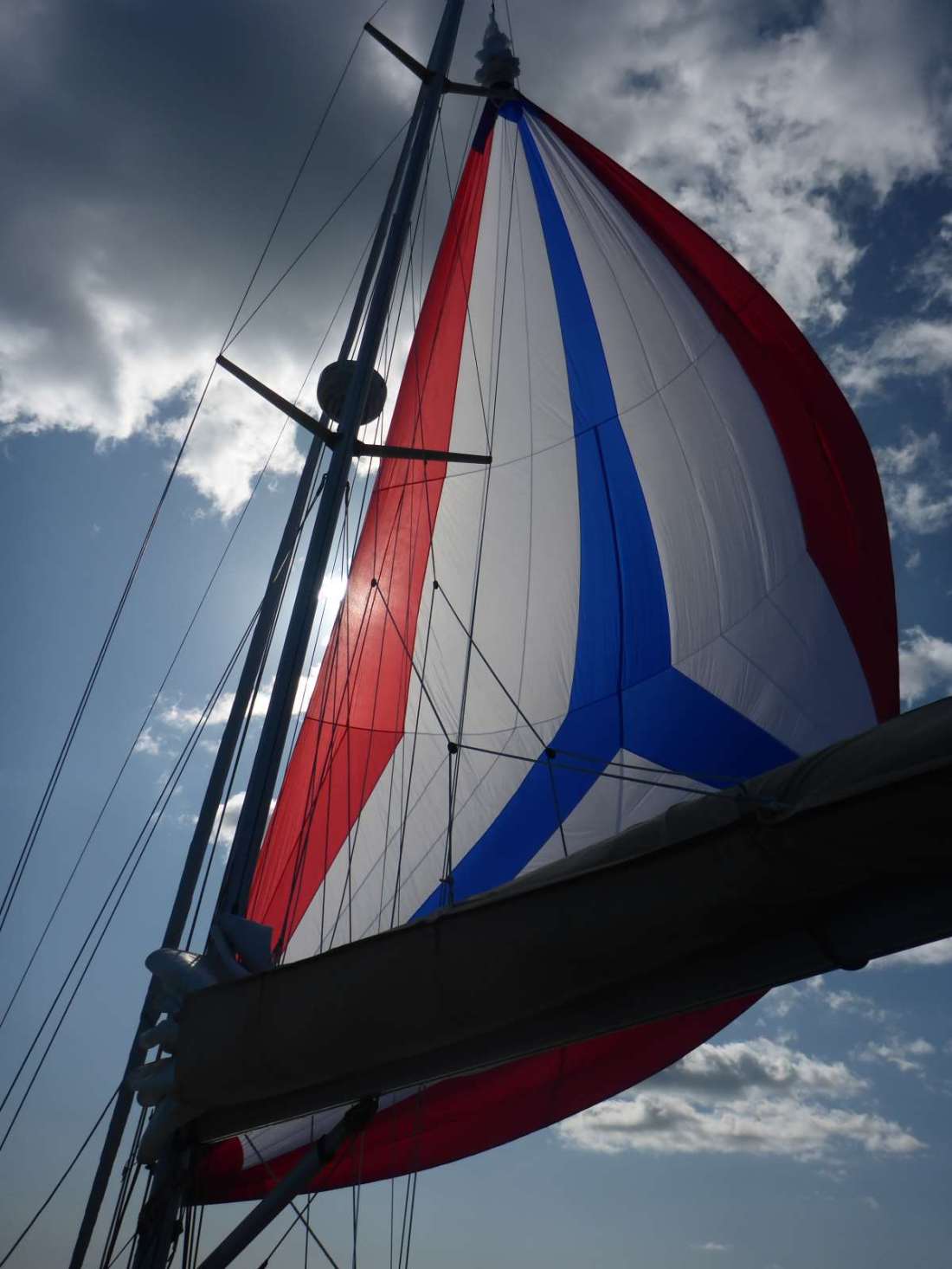
Sailing with just the cruising chute
Spoke too soon… as we closed on the coast of north Norfolk, shipping seemed to converge on us from all sides. At one point there were 7 boats coming at us from 3 directions, at speeds up to 14 knots. No idea if any of them had seen us. Eeek! Brief evasive action needed: as a gap opened up between the traffic, we scuttled into it before resuming our course.
Things didn’t quieten down even when we reached the channel inside the sandbanks that runs down the coast. We expected to have this to ourselves but some surprisingly large traffic was tramping up and down it, added to which the wind suddenly picked up to fearsome levels. Helen was woken from a comfortable snooze on the floor of the saloon by sliding from one side of it to the other. We were still under full sail. Charging downwind in a narrow channel, in poor visibility, with lots of other boats about was not Helen’s ideal scenario, although Alex thought it was making life more interesting. Brought the mainsail down completely, never mind reefing, plenty of power with just the jib. For once we were grateful for the adverse tide that would slow our progress towards the tricky narrow section ahead until daylight.
Sailing at night……this is about as much as you can normally see – just instruments and red/green nav lights
The entrance to the Yare is straightforward and, as the river is narrow and the tidal flows strong, all movements are coordinated by Port Control through the VHF. No complicated marina to negotiate this time, just a matter of tying up to the wall of the town quay. This is a manoeuvre we are not very familiar with so we were employing the best traditions of “making it up as we went along”. Alex didn’t particularly enjoy bringing the boat alongside the wall, as the strong current was rapidly dragging the boat up river towards the Haven bridge. Holding the boat alongside while putting out lines was rather stressful, particularly as (for some reason) the current was pushing us away from the wall. The investment in those large fenders, and months of aggravation of getting them all in and out of the cockpit locker every time we berth suddenly repaid with interest. Organising the warps to allow for a 2-3m of rise-and-fall took a fair bit of experimentation too. Still, we were eventually tied up snugly and delighted to find out from Google maps that there was a crazy golf course within half a mile.
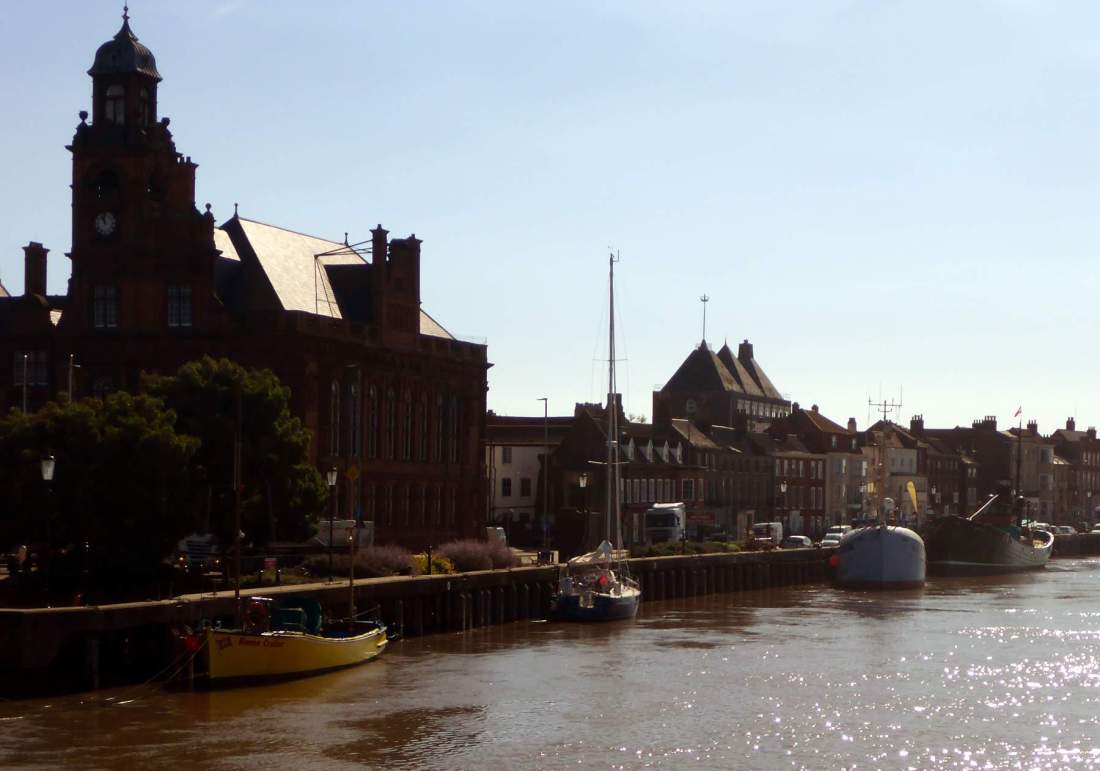
Moored at last alongside the wall at Great Yarmouth town quay. The river looks tame but the current is strong…
Lindesfarne provides a sheltered anchorage between Eyemouth and Newcastle, in the shadow of Holy Island and adjacent to an enormous colony of grey seals. The seals kept up a continuous sighing, moaning sound for the duration of our visit, which was rather eerie. At night we could hear their noisy snuffling close to the boat, and were disturbed by one of them swimming into the rudder at midnight, giving us a real clunk.
On a sunny and blustery day we kayaked ashore to walk around the island, alternately scrambling up and down the sand dunes and sitting on the shoreline to watch the world go by. Despite being well aware of the tidal nature of the island, we were almost caught out on the trip back. We were distracted by the dozen or so seals that came out to investigate us and didn’t notice how far down-tide we were being carried in the kayak. A furious paddle was required to regain the distance to Ventata, the seals making light work of keeping up with us. Thought they might have offered us a tow! However, some of them were pretty big so on balance we were happy they didn’t come any closer. Wikipedia suggests they live up to 35 years and adults weigh 200-300kg. (Note to check that rudder when we get back.)
Sandy walk around Holy Island
Surrounded by seals
The next anchorage, at Amble, was decidedly less comfortable. We had decided not to go in to the marina so anchored off the sandy beach and rolled around for the following 8 hours in the persistent swell. We watched a yacht approach the marina, fenders ready, and change its mind after seeing us – it went slightly further up the coast to anchor. We hope they didn’t blame us for a rather sleepless night…
Our arrival at Newcastle coincided with preparations for the Great North Run and the last few days of the Great Exhibition of the North. We had a pleasant day wandering around the city centre and admiring the many bridges over the Tyne. However, the Baltic art exhibition was, oh dear, just dreadful (to our taste anyway). The building redeemed itself with a mirror at the bottom and top of the stairwell that created an illusion of infinite height and depth – vertigo-inducing even when on the ground floor.
The New Castle at Newcastle
Bridges over the Tyne (many)
Optical illusion
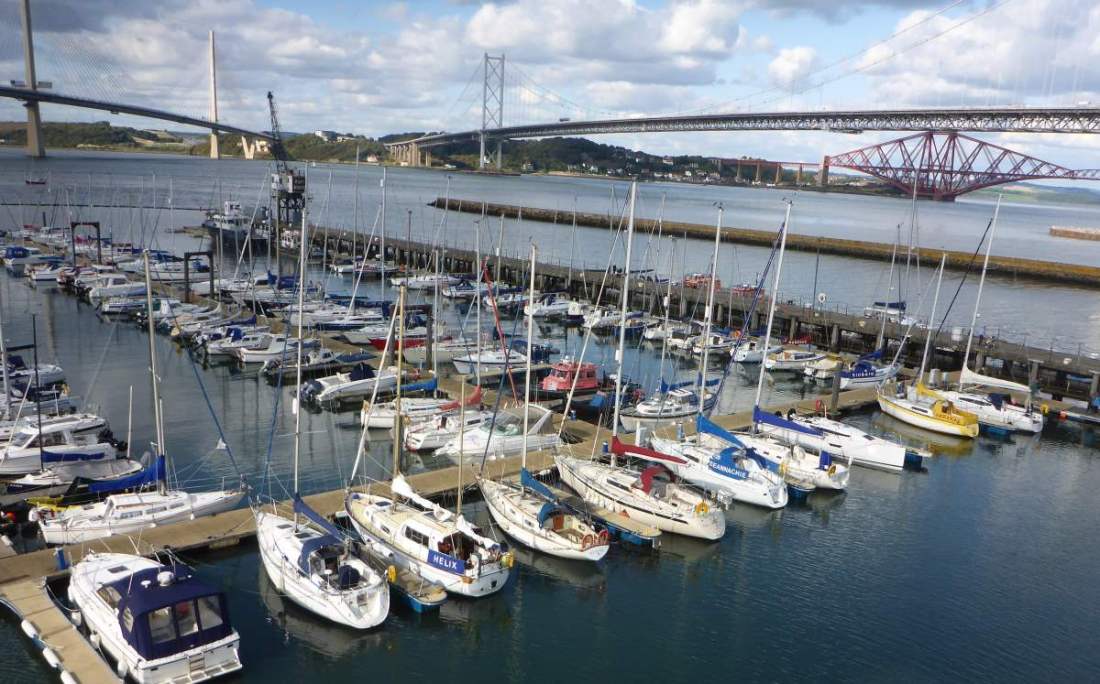
Royal Quays marina had the most luxurious facilities we have experienced since Ireland. We had expected Port Edgar marina, near Edinburgh, to be similar but it currently resembles a building site, with a half-mile walk to the facilities across an unlit assault course. However, whereas Port Edgar sits in the quaint and attractive village of Queensferry, Royal Quays has all the advantages supplied by North Shields. In spite of this, our stay at Royal Quays was so pleasant that we had a bit of a motivation failure when it came to leaving. The tide times dictated an early start and we had intended to get through the loch and lie on the waiting pontoon pending a 2am departure. But when it came to time to move, we agreed we just couldn’t be bothered. We had a bath instead, and a cup of tea in the marina bar.
With a later departure, we didn’t have time to get to Whitby before the water ebbed and we headed into Hartlepool instead. This has proved a mixed blessing. On the plus side, there is a cinema within sight of the marina, so we got to see Tom Cruise playing Tom Cruise in Mission Impossible Fallout, as well as HMS Trincomalee, a wonderfully restored 48 gun Royal Naval frigate, on Helen’s birthday. It was less fun trying to follow the route of the English Coastal Path: the path was disjointed, badly signposted and covered in dog poo. Too much high security fencing for an urban area, buildings near the football club have protective screening over their windows and there is dog poo everywhere: this is “not an entirely harmonious community”, as Alex put it. Did I mention the dog poo? A shame, as the woodland and rolling farmland were rather pretty once we got past the “keep out” signs.
Many years ago, when driving home from Italy, we decided to drop in to Munich because Alex wanted to visit the BMW museum. We were surprised by how busy the campsite was and it turned out our visit just happened to coincide with Oktoberfest. With a similar lack of planning, after catching the rather good bus service between Port Edgar and Edinburgh, we found we had hit Edinburgh on the last day of the fringe festival. On impulse (because it appealed to Helen) we bought tickets for the acclaimed Soweto Gospel Choir and later spent 30 min in an orderly queue in the rain to get in to the stunning Assembly Hall. Good fun, and an opportunity to sit down for a few minutes. Helen in particular was rather low in energy. However, an oversized cake afterwards in lieu of proper food did not seem to help matters.
Edinburgh Assembly Rooms
Edinburgh Assembly Rooms
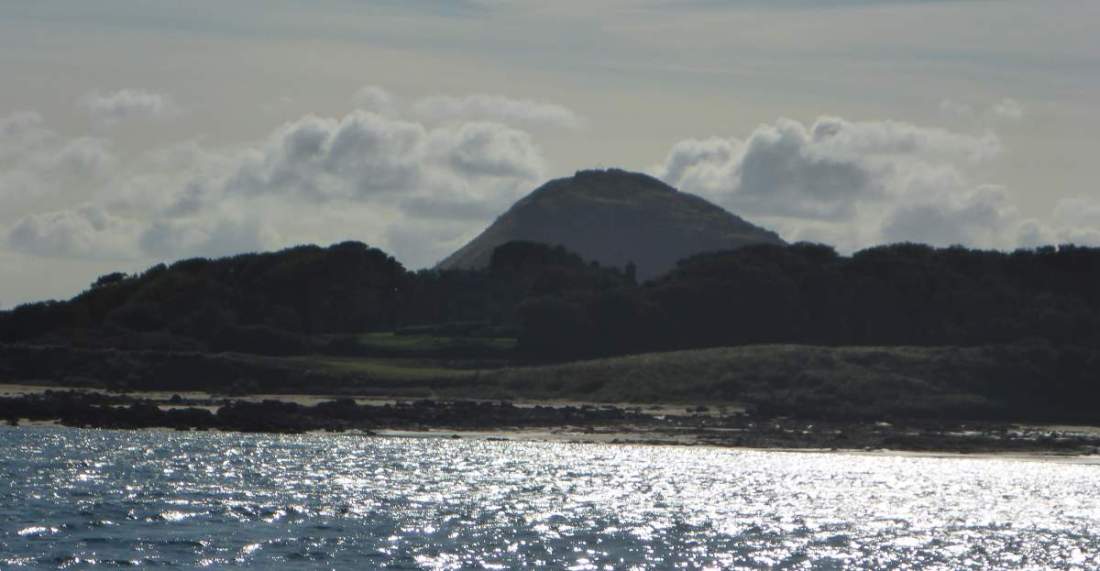
We were both despondent when leaving Port Edgar, feeling we had not done the place justice after all the effort made to get there. However, it was easy sailing downwind, to a pleasant anchorage off North Berwick. This is at the entrance of the Firth of Forth, under the shadow of Berwick Law, which Alex recalled climbing when on holiday as a child and where Helen, with surprise, caught a large mackerel.
Berwick Law
Helen has been enjoying fishing more and more. Initially there were a few qualms – if we caught a fish there would be the messy business of dealing with it – but our confidence has grown as our experience has shown we can spend hours with the rod over the side without any danger of hooking anything. Still, unless you are vegetarian, it seems right to face the experience of catching and killing your own food. The mackerel tasted great, after gutting, filleting and pan-frying.
For weeks we have been watching nature at work in all its blood and gore, and judging by the size of the gannet colony we passed the following day, there can’t be a local shortage of mackerel. Bass rock, sitting in the entrance to the Firth, is absolutely teeming with them. From a distance it appeared as if it was snowing over the rock, and for 15 miles up the coast we passed raiding parties of up to a dozen birds hunting together.
Black Rock gannet colony – the rock is black, the gannets are white
Every white dot a gannet
Our destination, Eyemouth, had a narrow rock-strewn entrance leading to a pontoon right in the centre of town. Not quite enough water for us, especially at spring tides, but the bottom was soft and Ventata wiggled her keel half a metre into the mud each low water. The pontoon was dead on the route of the coastal path which was good for walking, if not for privacy. A well-defined, rolling path took us on wonderful cliff walk to St Abbs Head for lunch, and also provided the first blackberries of the year. And, on departure at about 7am we had absolutely the best send off from Scotland that you can imagine, with a pod of dolphins jumping along our bows as we exited the bay.
In a scene in the film Crimson Tide, the captain of a US nuclear sub (Gene Hackman) and his executive officer (Denzel Washington) disagree violently about the merits of purposefully staging a missile drill while simultaneously dealing with a serious galley fire. The gist: Washington: “are you mad, doing that with all this chaos going on?”; Hackman: “this is exactly what you want – this is a ship of war and war is chaotic, so use these opportunities to practice”.
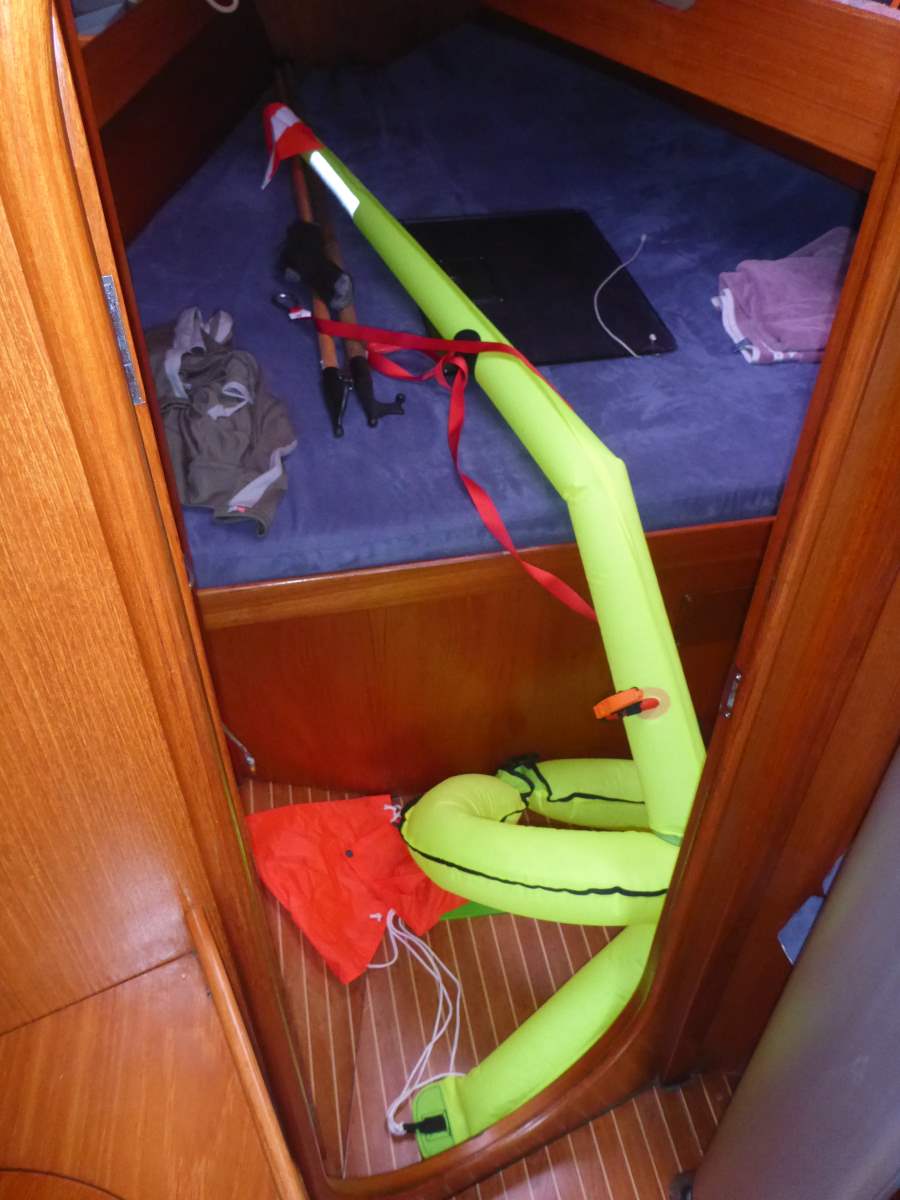
It felt a bit like that when, negotiating a tricky tidal situation south of the Orkneys, our man overboard recovery device exploded suddenly out of its housing, dropped into the water behind the boat and began to inflate. Oh great! We have renamed it Otto, after the unhelpful Airplane autopilot, and the rather similar humorous sound it made whilst inflating.
Although travelling east from the Orkneys, the cruising almanac recommends travelling 5 miles west of the exit from Scapa Flow before turning, to avoid being swept onto a nearby island by the east-going tide. With a typically unhelpful wind direction, we were already further south than we wanted when Otto decided to jump ship. A swift tack brought us back alongside and we recovered him back into the cockpit and resumed our original course. He sat in the boat for the rest of the journey, getting in the way and gradually deflating, just like his namesake, although Helen decided not to re-inflate him. On inspection, it seems Otto’s housing was wet inside (lots of rain recently), which must have triggered the automatic inflation; it was a good job we were around at the time, and was actually useful practice (we’re with Hackman on this).
Otto deflates in the forecabin
The rest of the day was uneventful: in light winds we were outpaced down the Scottish coast by our rower, in spite of having the cruising chute up. We anchored in Sinclair Bay while he carried on a few miles to Wick. He won’t have been able to keep up with us in the strong winds we have had subsequently. After a week in the Orkneys, we decided we needed to make up some ground and wanted to test ourselves on a longer passage. So, we left Sinclair bay at 7am hoping to do a decent hop, ideally all the way to Edinburgh, which would be more than 200miles.
It wasn’t to be: after 24 hours we’d got as far as Peterhead when the wind died. The guide book notes that by sailing a direct course to Peterhead, you miss the delightful coastline of the Moray Firth but, tacking with the wind on the nose all the way, we felt we’d seen more of the coast than we really needed as well as well as the oil platforms in the middle of the Firth. Light winds were forecast for the following period and with limited stopping points for another 40 miles, we put into Peterhead with a mix of disappointment and relief at being able to rest.
As it happens, we liked Peterhead. It is pleasingly industrial with huge fishing boats and pipelaying gear in the harbour. A bit of an ‘80s town centre but the coffee was good and some of the buildings are pretty. The owners of “Bay View” cottages may not appreciate the large hangers now obscuring the view of the bay though.
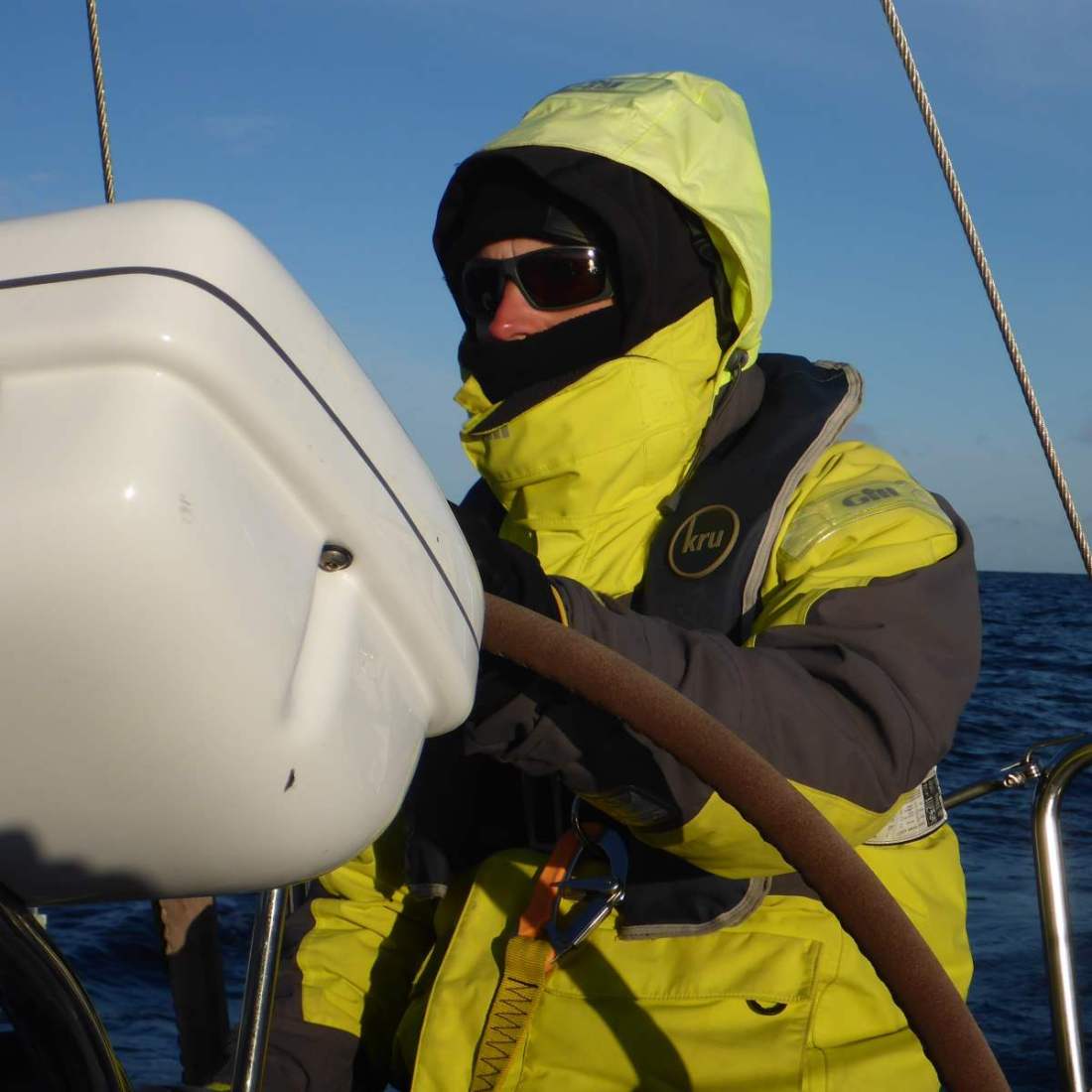
We carried on at 8:30 the following day, the 100th of our trip, marked by eating the final piece of our 2017 Christmas cake. This journey proved one of the most challenging yet. The headwinds continued, inconveniently adjusting as our course changed around the coast. For most of the journey we had around 25 knots. Beating into that for 30 hours was hard work! The helm requires constant attention; in the dark it feels like you are holding the reins of some wild thing, galloping headlong. Alex almost came a cropper when making tea, overbalancing and lifting a galley door off its hinges, then hitting himself in the head with it. Fortunately, Helen is more sympathetic than Alex, as he would have found this very amusing had it been the other way around.
The noise is unbelievable: wind whining in the rigging, the whole boat vibrating and crashing through the waves. We each got 30 minutes sleep here or there, between 90 minute shifts on the wheel, just about enough to keep functioning. Climbing out of bed is literal: it’s on a 30 degree slope and you have to scramble uphill to get out. For added challenge there is a lot more traffic on this part of the coast: we have become accustomed to being alone on the sea most of the time and suddenly there are large freighters and cruise lines tracking up and down the coast while we are tacking back and fro across their routes.
The conditions started to take their toll on Ventata. Just before it got dark the genoa halyard snapped and we had to take the sail down to replace it with one of the spinnaker halyards. Meant to replace it last year but didn’t get round to it. Anyway, it was good exciting stuff on the foredeck with the boat leaping around. Later there was a cracking sound in the cockpit as the block that secures the furling line failed, spraying bits and letting the heavily reefed sail out in full until we were able to winch it back in. Noted afterwards that the critical parts were plastic not metal; we will be more aware of this in future…
By 6am we had got to May Island in reasonable shape, all things considered, and ready to head up the Firth of Forth. The final 25 miles to Edinburgh was hard in terms of effort and patience. In its usual generous way, the wind became westerly, forcing us to tack all the way up to Edinburgh. With deep reefed sails, she doesn’t point well into the strong wind, so to make those 25 miles to windward we sailed 50 over the ground. However, we made it! In 4 days since leaving the Orkneys we were underway for 63 hours, 59 of them under sail. We logged 358 miles, motoring for only 10 (mainly up the narrow channel that comes under the Forth bridges). The following day we washed the salt out of the foul weather gear, bought a re-arming kit for the MOB device and 35 metres of nice new dyneema halyard which Alex has been up the mast to fit. Now, sort of rested, we will see what Edinburgh has to offer!
View from the top of the mast, while rethreading the genny halyard in Port Edgar marina
We have reached what, barring the unexpected, will be our most northerly point: 58 degrees and 57.8 minutes north! From here we will turn south – we are, oddly, feeling both sad about this and feeling there is still a long way to go. Already we have sadly watched our longitude decrease from -8.5 West (Kinsale) to -6.5 (Isle of Canna) to -3 (Stromness). (Incidentally, we have just updated the plot of our route on the other page if you are interested.)
Cape Wrath, despite the warnings in the pilot books, was benign. We had an early start from Loch Laxford, a rocky corner 20 miles south of the cape where we anchored for 2 nights, sheltering from the wind and trying (unsuccessfully) to catch fish. We soon found ourselves in the midst of the largest pod of dolphins we have seen yet; it’s also the first time we have seen them jumping out of the water. We passed our round-Britain rower again (we saw him on the AIS, emerging from a different loch, just behind us). Frustratingly, with little wind we had to use the motor for an hour to avoid the tide on the corner, which always upsets Helen.
Cape Wrath, closer than we expected to get
Fishing whilst underway
Once “round the corner”, we continued our unsuccessful hunt for mackerel off the back of the boat. We have concluded we are the worst fishermen at sea. We need more weight on the line (so have just been to get some).
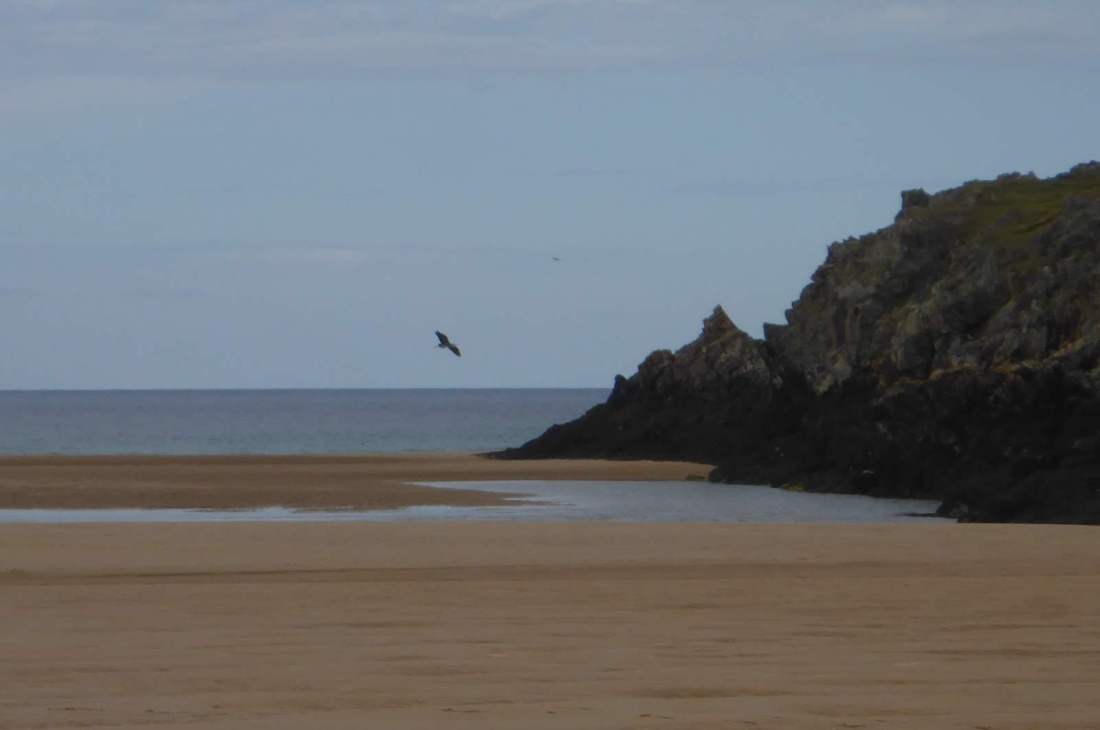
There are few sheltered anchorages on the north coast of Scotland – we selected Rabbit Island, Kyle of Tongue for an overnight stop, leaving a day’s sail to reach the Orkneys, 40 nm away. Getting into Scapa Flow requires care in a boat like Ventata as the tide in the sound of Hoy runs so fast. We set out at 6am to catch this tide, which was due to turn the right direction at 6pm. It was obvious, after a couple of hours, that we weren’t going to make it so, rather than motor, we put back in to the next bay up the coast to wait. It had a wonderful, clean sandy beach so we pumped up the kayak and rowed ashore for lunch. We’re pretty sure we sure an eagle flying over it. Getting back to Ventata was interesting (read “wet”) as there were breakers rolling onto the beach.
Probably a sea eagle, seen from the beach at Torrisdale Bay
We revisited our plan for the second Orkneys attempt: The wind was forecast to come to the east and strengthen from late afternoon, and though idyllic, the anchorage was too tippy for a good night’s sleep. We decided on a night crossing and, after much debate, a 9pm departure, on the basis that if we made an average speed of:
·4 knots (normal in light wind), and didn’t need to tack, we would arrive (at the sound) at 7am
·5 knots (easily do-able in decent wind in the right direction) we get there at 5am and wait
·6 knots (possible given the forecast) we would be even earlier, and would carry on further, with an alternative anchoring option in the northern part of the islands
·3 knots (has been known) we would need to motor otherwise we miss the window
But, if the wind moves from the east to the north east and we needed to tack, the 40 mile journey becomes 60. We would still be OK if we made 5 knots, any slower and we may need to motor (see above about Helen’s view on this).
At 9pm we departed to a beautiful sunset. Stars came out – always useful as it is horrible steering with nothing to get your bearings. We reefed at about 23:30; it was still just light, we are so far north. Many shooting stars (Perseid shower). The sea was flat and the wind smooth and strong; we put in the other reef later on. Overall a glorious sail. We needed to put in a couple of tacks but arrived off the Sound of Hoy at about 7am. We took the main down as we approached the narrows, and sailed through sideways at over 10 knots, just motoring the last mile or so to berth in Stromness.
Dawn at sea – colder than it might look!
Since then we have had a great week being tourists. Unfolded the folding bikes, bought an explorer bus pass and have been touring the sights: Neolithic settlements, WW1/2 defences for Scapa Flow, Old Man of Hoy. An unexpected highlight was the RSPB eagle watch station – they have been watching the first sea eagle chick to hatch here for 140 years, and we were lucky because, although it has just fledged, it still returns to the nest site and happened to be there when we passed by. They say “chick” but it is absolutely huge!
Ring of BrodgarStaff at Skara Brae warned us about the busy road on our route to Brodgar. They obviously haven’t been to Bracknell…
Our return to the Scottish mainland was to Loch Ewe. The entry is marked by numerous look out stations and disused gun turrets, having been the main despatch point for the Arctic convoys in WWII; it is still a NATO staging post.
In spite of this status, and of being within 5 miles of the Loch Ewe VHF transmitter, at our anchorage we were unable to pick up the coastguard weather reports and there was no mobile signal or internet (though wherever we go ashore we seem to almost get run down by a BT Open Reach van so maybe they are working on that). In the end we had to go to the Inverewe garden café for lunch and wifi, just to get a weather forecast. Not a problem, as Inverewe gardens, was our reason for anchoring here: an improbable oasis of plant-life shelters behind a cover of scots pine planted to provide protection from the elements. They were established in 1862 by Osgood MacKenzie and continued throughout his lifetime and afterwards for 30 years by his daughter, before being handed to the Scottish National Trust.
Loch Ewe military defences
Very small part of Inverewe Gardens
The damp weather did not improve, and we spent most of the following day re-stitching the UV strip onto the genoa. Most of the stitching on the foot and a good number of places on the leech needed attention. With the tough material, this became more and more painful on the fingers, even though we were simply putting new thread through the existing stitch holes. With both of us working on it, it took about 8 hours!
Meeting the locals at Lochinver
Moving north, with dwindling supplies and depleted batteries after days at anchor, we came into Lochinver, which sits under the shadow of the rather peculiar shaped mountain of Suilven. Walking up it was one of the most spectacular hill walks we have ever done. In rare, cloud-free moments the top is visible from the pontoon where we were moored, so no messing about with buses or bikes to get to the start. There’s a pleasant 5 mile walk in, gradually gaining a couple of hundred metres of height, then it’s a mile straight up the side of the hill to the summit at about 800m and back down (somewhat footsore)the same way. There were some “airy” moments crossing small ridges with big drops on both sides, and a few bits of scrambling but, miraculously, the conditions were perfect: dry, clear and with a well-constructed path (unlike some of our previous walks)that avoid wading the bog and unstable slopes. The views from the top quarter are amazing, the beautiful landscape of north west Scotland is laid out, mountains surrounded by rivers and lochans and far out sea.
This post has been rather delayed by lack of internet signal in the remote corners of Scotland! No chance of uploading an update or downloading the Archers omnibus. In places there has been no DAB or FM radio, and for the last couple of days we have struggled to get even the Stornoway coastguard weather reports.
The Scottish scenery is amazing. Dramatic shorelines with waterfalls overflowing from the cliffs, rugged countryside with high mountains above, and amazing waterways in between to explore. Pairs of puffin, groups of guillemot everywhere; gannet common both individually and in small formations. No sign of the local eagles but Helen thought she saw a whale near Canna. ‘Though it was gone before you know it and Alex wonders if she really saw anything at all…
The views are so good it’s a shame you can so rarely see them. This morning the cloud is barely above the mast. For more than half of our time here it has been raining and the boat is full of wet sailing and walking gear.
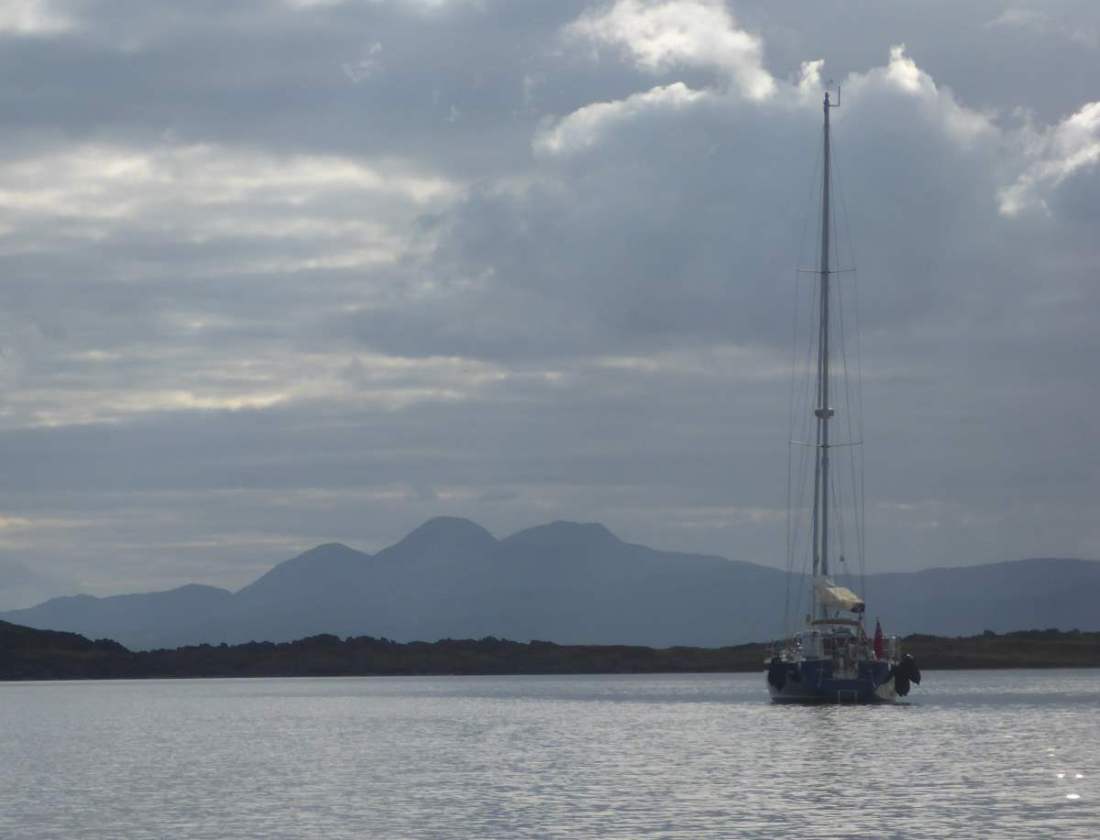
After leaving John on the fast ferry out of Jura, we drifted miserably up the sound of Jura and picked our way into a rocky inlet in zero visibility. The following day was fine and we walked 5 miles across the peninsula to Tayvallich for milk and a newspaper. (Later decided that the milk was too heavy considering the 5 miles back.) From there, we headed north, spending a rare, sunny evening in a glorious anchorage north of Kerrera, perfectly sheltered and surrounded by mountains.
At anchor, half-way up the Sound of Jura, Paps of Jura in the background
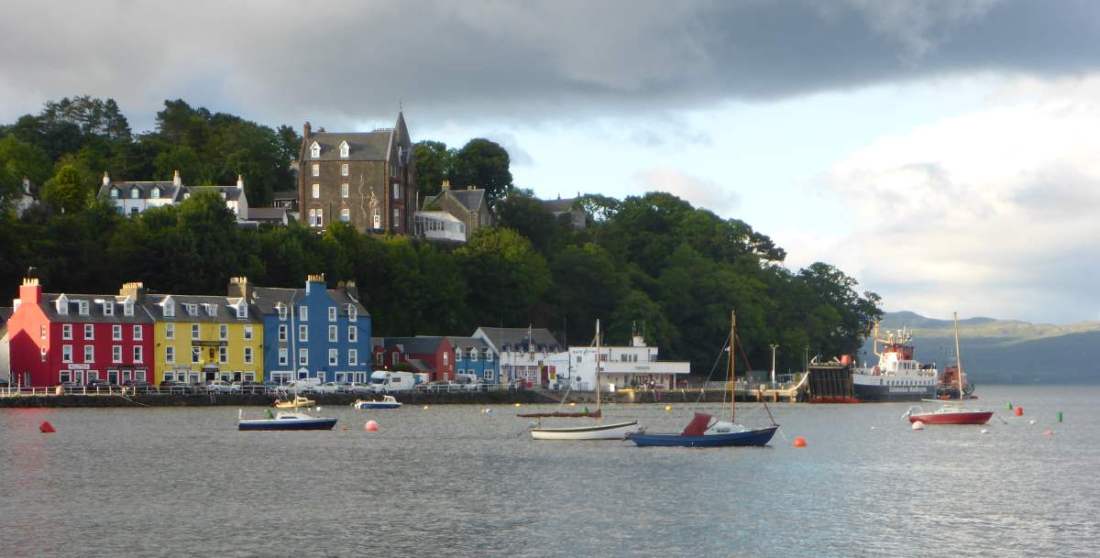
Then north west through squally conditions up the sound of Mull. No wombles in Tobermory but they have a great aquarium where the exhibits are temporary visitors that are returned to the sea after a few weeks on view. We each bought new trainers and, having spent too long over this, sprinted in them 2 miles through the woods to the Mull theatre, where 3 local actors were putting on a short play. Didn’t recognise the star with previous credits in Cracker and Holby City but the play was entertaining, and was followed by food, wine and a Q&A session with the cast. The main character was offered repeated opportunities to thieve a life-changing sum from a faceless organisation and elevate his miserable existence to a higher plane, consistent with his peers. What would you do?
Tobermory
As we turned north from Tobermory, for an overnight stop off Canna, on our-route to Skye, we noted the other boats all went south! Perhaps they were not keen on the F8 (gusting F9) that picked up. We have become practiced at shortening sail quickly – it doesn’t seem to matter what the forecast is, big hills combined with big clouds seems prone to give you 45 knot gusts. It is also easy to make mistakes in these conditions.
Skye offered excellent mooring facilities at Carbost, at the head of Loch Harport and the location of the Talisker distillery. Our arrival was marked by driving rain and head winds that made it difficult to see the mooring buoys as we approached. Determined to see some the island we had a walk into Glen Brittle forest, draining the water from our shoes every few km. We tried a drying out spot in the distillery on the way back, but declined the option to pay more for a bottle of Talisker than at the Supermarket at home.
Stopping to wring socks out in Glen Brittle forest
Cuillin view, from Carbost (when the cloud is high enough!)
We left Skye in thick mist with visibility down to a few hundred yards. As we tacked out of the loch into a 25 knot headwind, rocks appearing from the mist on either side, a bodged tack resulted in a riding turn on the winch and a rather nasty game of free the sheet. Incidents such as this, and accidentally unfurling rather than furling the jib, have taken their toll on the sail. We thought the foot was coming unstitched but were relieved to find it is only the protective UV strip that has come adrift. It needs re-stitching before we move on – a good job for a rainy day, and there seems to be plenty of those!
Our final couple of days in Ireland were memorable for sea birds, a super, cliff-top walk to the Giants’ causeway and strolling on the beach at Ballycastle in the evening sunshine. Also, for the highly amusing spectacle of a bus driver trying to explain to a French tourist that, the local currency being Sterling, he is unable to take Euros as payment, with fellow passengers vying to exchange his 20 Euro for a suitable number of pounds.
From Ballycastle (north coast of Ireland) we had a clear view of Islay and the Scottish mainland. By halfway across the North Channel to Scotland we couldn’t see anything apart from the inside of a cloud, and it didn’t get better. We anchored off Islay but could barely see it, and then moved through the murk to one of the rather splendid new moorings outside the Jura distillery. The business plan for the moorings looked pretty sound based on the amount of trade generated by crews of visiting yachts at the distillery and hotel bar. One boat with 8 guys on board came back with bottles of whisky and by late in the evening we had half clothed sailors trying to get their dinghy to do doughnuts around their yacht; we now know we are back in the UK.
Yesterday we woke up to a traditional Scottish day of mist and rain. Walking through a midge-laden swamp on Jura we had such bad visibility that we couldn’t see the sound of Jura, and often couldn’t even see the path, never mind the hills above.
Walking in Ireland
Walking in Scotland
On a positive note, we have enjoyed having John on board with us for a week. Long suffering friend, IT consultant, suspected tax-avoider and creator of the infamous non-setting jelly, he has been patiently teaching us the difference between guillemot and razor bill. However, we have a feeling that he is relying on our complete incompetence in this area so could probably tell us anything.



















 Ventata