2 months without toast

Our previous boat had a grill.  As we normally have a high-toast-content diet, we miss this, so for lunch today we went straight for the toast (scrambled egg option) at a local café in Bangor.  Little things.  We have spent a pleasant few days here awaiting our new crew member.  (Would have been a shorter wait if he hadn’t missed his flight to Belfast, but then we wouldn’t have found the scrambled egg and toast.)  The local council has worked hard to create a Bangor walking tour with limited historical and cultural material at its disposal.  Highlights were an Edward VIII post box (which isn’t actually a post box as far as we can see), Bangor castle museum (fairly recent but nevertheless in an impressive setting) and, the reason we came here in the first place, the Pickie Fun Park Mini Golf.  Alex won this major sporting event by 3 strokes.

On the way to Bangor we spent a couple of days in Strangford Lough, a pretty place with an “interesting” entry: several miles long with tidal flows as high as our maximum speed and narrow enough to need frequent tacking when the wind is against you.  (It was.) Near one end there’s a huge tower to support the tidal barrage.  It looks benign enough at slack water but at full flow (as it was when we came in) there is a huge wave piled up against it on one side with a corresponding hole in the water on the other and a big slope in between.  The whole thing is painted black and red (colours of the isolated danger mark) and you would think it should be easy enough to miss, but it comes at you very quickly when you are tacking in a 6 knot stream with 25-30 knots of wind!

We had a decent sail up here from Strangford and have seen many more cruising yachts than in the previous 3 weeks in the Republic of Ireland.  Some of them were even sailing.  As we try to avoid using the engine we are always amazed at the number of people motoring about in sailing yachts, in conditions that seem perfectly good for sailing.  However, the engine is certainly useful from time to time.  The last few miles to Bangor from our overnight anchorage off Copeland Island had taken quite a while before Helen relented (under pressure) and agreed we needed to motor if we wanted to arrive the same day.  Pros and cons though.  While drifting about aimlessly on the tide we had a small bottlenose dolphin circle the boat a couple of times, coming close enough for us to hear it breathing when it crested the surface.  Don’t think we’d have seen that with the motor on…

On windless days we have been ticking some odd jobs off our list: took one of the halyard winches apart as it has been making strange groaning noises and found a plastic washer in pieces in the bottom.  Have replaced with a copper one and will see if that is good enough.  Traced our mystery 0.5A current drain to a combination of the CO alarm and the stereo and have now wired them in properly to the circuit breakers and switch panel so they can be switched off when not in use.  Finally, we wired in a new pump for the fuel cell waste container so we can clear it without having to empty the cockpit locker!

Changing scenery

The coastline has become more mountainous and we picked up Belfast coastguard on the VHF for the first time yesterday.  Coming into range of new coastguard stations always feels exciting, like we are making progress.

The weather is still dominated by the high pressure and its fluky wind conditions.  On a 20 mile straight-line course from Skerries to Carlingford Lough, we went from being close hauled on port tack, to having no wind at all, to picking up a new air flow that had us close hauled on starboard tack, which finally freed up to become a rare beam reach.

We love this country.  Helen would like to live here (Alex prefers Dartmouth).

The sailing centres are buzzing – dinghies, yachts, keelboats, kids of all ages, boats constantly coming and going and the yacht club bar doesn’t stop serving food until people stop coming in for it (pretty late).  Strangely, while there seems a keen interest in racing, there doesn’t seem to be as much sail cruising.  We have seen more Canadian and Belgian yachts than Irish ones touring the coastline!

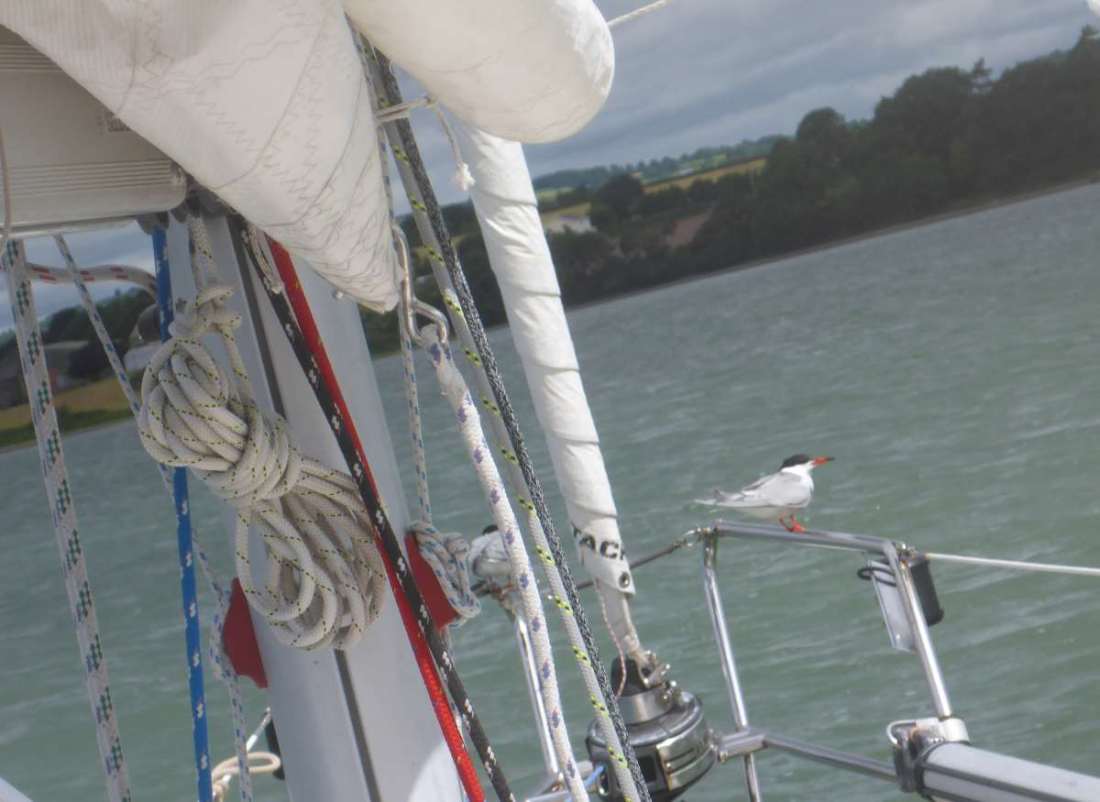
There are sea birds all over the place, we are struggling to identify them all.  Herons are less shy than at home – we have seen one in every marina.  They stalk the pontoons and stand on the bathing platforms of motor yachts, plucking passing fish out of the water.

Having now listened to a lot of national radio, it is clear that Ireland has pretty much the same issues we have at home: house price inflation, pressure on the health service, overcrowded public transport in major cities and (despite bring so wet) hosepipe bans when the sun comes out, with water companies blamed for high leakage rates.  Refreshingly, the quality of debate is much better than at home.  The radio presenters host relevant and knowledgeable guests daily and are able to carry out informative interviews that get to the detail without the pointless point-scoring.

Apart from a lack of skimmed milk and coffee bags, the biggest differences we have noticed from home are the genuine welcome and lack of reserve.  Wherever there are two or more Irish people in the same place there is a conversation going on.  In the marina shower block, I found out that my 3 companions were a novice diver, a final year vet student and a compliance manager in a phama company, also hair conditioner is a good lubricant if you are struggling to get a tight wetsuit on.  At home there are plenty of people we have known for years, without really knowing them at all…

We are poised now on the border between the Republic of Ireland (on the south bank of Carlingford Lough) and the North (on the north bank); it is Euros on the south side, pounds on the north, and a ferry going to and froacross the river – we wonder if they have border checks!  Our next journey will take us back into the UK.  We have freely moved about the country and the seas around it for the last month, without question and with a welcoming, friendly people. We wonder what the differences might be in 2 years time…

You won’t believe this!

We finally found some wind today.  OK you can believe that bit.  Rather than sunscreen, kayaking and general tourist behaviour (some great photos to share in a future post) we have been able to worry about sunscreen and living at an angle again.  Pouring milk is a particular problem, and many of you know how we meter the addition of milk to tea very carefully.  Not easy on a moving platform.  On port tack you have to strap yourself to the stove while preparing food and on starboard you can’t wash up because the sink fills with salt water rather than draining the other way.  Whatever you are doing you have to brace yourself against one wall or the other.

But a decent 15-20 knots of wind means we finally made it around the south west tip of Ireland and have started heading north.  After a 4am start, we anchored this afternoon at Wexford Bay, just north of Rosslare.  It’s not the most sheltered of anchorages and not the most crowded (we were the only ones here).  But who should rock up, sometime while we were watching England loose to Belgium and generally feeling a bit ill in all the rolling around, but our round-Britain rower.  We saw Andy on our first evening, moored at the Isle of Sheppey, and here he is again.   What are the odds of that?   And while we have generally been pretty pleased with our progress and minimal consumption of diesel, Andy has rowed the same ground.  Respect!  Please sponsor this guy, he must be amazing.

Change of pace

After all the excitement of getting to Ireland, it has been very quiet by comparison ever since.  We had some time off in Kinsale and in Cork to celebrate Alex’s birthday.  It’s the first time we’ve been to the cinema since a disappointing experience in Bracknell with The Two Towers!  A 5 star verdict on Solo but the overall experience was probably enhanced by there being fewer than 10 other people at an unpopular matinee screening.

This slideshow requires JavaScript.

Not sure we made the most of Kinsale as the gourmet capital of Ireland, our experience being limited to take away fish and chips, an outstanding cream tea at Charles fort, a rather poor supermarket pizza and some quite nasty spiced sausage rolls.

The local supermarket chain we have decided is equivalent to Spar shopping at Waitrose prices.  However, a great success so far is meals on the Mr D no-power slow cooker.  It’s not quite no power: you have to fry / mix the ingredients and get everything on a rolling boil before transferring it all to an insulated jacket where it cooks away for the afternoon and emerges delicious.  We had the first half of a herby chicken / bacon / vegetable casserole last night; the other half is in the fridge for tomorrow.  It appeals greatly to Helen as it reduces the amount gas and effort per serving; also the amount of meat per serving as Alex doesn’t seem to mind vegetables / beans going in.  She will claim this is all much more sustainable but it actually just appeals to her inherently stingy nature.

Otherwise, it has been pleasant temperatures and light breezes.  Not much good for sailing, and we haven’t managed to make much progress up the coast.  Some pretty coastline and lovely anchorages though; tonight we are in Ardmore Bay.

A new experience anchoring last night at Youghal: very poor holding.  We have become somewhat nonchalant about anchoring on the east coast mud – you just drop it and it sticks.  At Youghal when we reversed the boat to dig the anchor in, it just towed along the bottom.  Repeat attempts no better.  So we set the anchor alarm and turned in for dinner, knowing there would be no wind to speak of and hoping it was up to the significant current.  We left the torch and all the clothes out, the instrument covers off and the engine battery switched on, all in the expectation of needing to make a quick get-away.  Not conducive for a good night sleep, with the steady rumbling groan of the anchor chain.  However, although woken by the alarm on the change of tide it was clear we were not going anywhere far, so back to sleep.

Not much sign of improving wind conditions so we are going for a strategy of getting up late, leaving after lunch, drifting for a few hours with the tide and putting the anchor down wherever we get to.  This gave us time to watch the Panama game today, and we will explore the craggy cliffs by kayak tomorrow morning.

Day35 UFO
Pair of visitors making themselves at home at East Ferry, Cork Harbour

White knuckle ride across the Irish Sea

Having had no wind on the way to the Scillies and a couple of days of calm weather to explore the islands, it was time to plan our departure.  Obviously, this meant the onset of gales.  Figured that heading out into the Irish Sea with high winds and rough seas forecast was likely to be uncomfortable.  Delaying 2 days gave us a chance to do a couple of odd jobs including fixing a couple of minor leaks with the all-purpose fantastic, if fantastically expensive, sealing-gluing-gunk Sikaflex291.

We also remade the splice between the anchor chain and rope.  This followed being woken at 4am by Alex’s anchor-alarm app, notifying us we were no longer quite where we used to be.  Although New Grimsby Sound was sheltered from the seas breaking outside, in the high wind we dragged our anchor into deeper water, a vicious circle because as the water deepened, the inadequate length of chain became progressively more so.  It all traces back to a problem we knew of but had never fixed: the splice that joins chain to warp was too fat to fit easily through the windlass so we have tended to anchor only on our 25m chain.  In the shallow waters of the east coast, we had got way with this for 18 months.

After 3 days of scrutinising multiple weather forecasting services, we decided that the conditions looked manageable for a 48-hour window, plenty to get us to Ireland.  Unusually, the passage plan was very simple: leave mid-morning and head in whichever direction we could make comfortably with the westerly wind.  Whatever our speed, we would arrive somewhere or other in daylight the following day.  Where though?  Baltimore looked right out (too far west), a shame as Helen won’t see the Fastnet Rock.  Kinsale looked promising, Kilmore Quay (east) if need be, various possibilities in between or, if everything went badly wrong, Pembrokeshire!

Everything felt good as we left.  Kinsale looked likely, at a close reach; easier than a direct beat to windward.  As forecast, the wind rose (we took in reef 1) and rose (reef 2).  It got dark.  Not forecast by any weather app we had looked at, the wind continued to rise to a sustained 30 knots, gusting high 30s.  (Force 7 gusting 8).  It became a roller coaster ride.  The boat was supreme, charging through the waves.  We can’t have done too bad a job in setting up that wonderful Petersen rigging after all.

Helming is hard work in these conditions, we did hour long shifts in daylight, 45 minutes in the dark. Ventata’s deep fin keel, that makes her so manoeuvrable, means you tend to get knocked sideways by every wave.  You steer instinctively, trying to react to each wave before it grabs and spins you, keeping the wind just ahead of the beam.  Now and again you get hit on the quarter by one coming from a different direction, sending everything sideways that is not tied down. 

It started to rain.  The wind came round as expected, making us close-hauled against it.  In these conditions Ventata seems to go through the waves rather than over them.  Lots of water comes over the bows; sleeping is a challenge.  The boat is continuously heeled to leeward, so if you lie on the windward seat you roll off.  The leeward seat is not attractive as water landing on it doesn’t drain.  So, when not helming, we each got some sleep curled up on the cockpit floor with a pile of wet ropes – nice!  The helmsman doesn’t get away from it either: any water landing on the windward side deck runs backwards and forwards, collecting until it reaches a groove in front of the rear cockpit locker and then empties periodically into their boots

Finally, after about 140 miles on port tack, we started to get some shelter from the Irish coast and made it into Kinsale about 25 hours after leaving the Scillies. We have also found a new leak into the cabin . However, we had a lot of comments about Ventata on arrival (“a grand offshore yacht”) – clearly a discerning lot, the Irish.

Furthest south

On Sunday we passed the Lizard, expected to be our furthest point south and the first time our position has dipped below 50 degrees N.  Spent a pleasant couple of days previously, wandering around in Falmouth and meeting up with Helen’s parents.  We had coffee at the same café where, 18 months ago after viewing Ventata, we agonised over whether to make an offer.  Mum and Dad seem concerned about our weight as they brought an enormous quantity of food and treated us to a couple of meals out.  We are particularly enjoying the chocolate brioche; not sure it is much good against scurvy but it goes down very well with morning coffee.

Lots of coming and going at the Falmouth Town Quay.  We noted a couple smallish sturdy boats, fitted out for offshore voyaging, which must have been the first arrivals for the Golden Globe Race: leaving from Falmouth this week, it commemorates 50 years since the start of the original non-stop around-the-world race, of which (now Sir) Francis Chichester was the sole finisher 312 days later.  Puts our expedition nicely into perspective!  On our own departure from Falmouth, Helen finally had to admit that the nasty bow thruster has its uses: we were pinned onto the pontoon between two other boats by a decent side wind and it made easy work of a manoeuvre that had a lot of potential for going wrong.

Sadly, that wind didn’t last beyond the Lizard.  We persevered with the spinnaker, then poled-out the jib, then the asymmetric, and back to the spinnaker, but eventually had to resort to motoring.  Very unsatisfactory, particularly with the batteries already charged.  The only saving graces were of drying out the spinnaker (accidentally dropped in the water on its inaugural outing a few days before) and getting us to the Scillies in time for a fine bottle of Betty Stogs Brazen Cornish Bitter (4%) in the cockpit before dinner.

The Scillies are very strange: an isolated cluster of low islands with the surrounding seabed 70m below the water in all directions.  Leaving the English mainland, we were very aware of the open water on all sides.  From our east coast base, even in the North Sea, you are never that far from land but from here you can go approx 150 miles N, 2000 miles W or 600 miles S without land or shelter.  An interesting thought as you step into the kayak to go ashore…

In the last couple of days we have been anchored off Tresco, which is apparently leased from the Duchy of Cornwall, but Prince Charles has not been out to collect anchor fees. It has the great feature of having no cars, and is a very relaxed environment. We have walked around most of Tresco and neighbouring Byher.  The vegetation ranges from familiar low grass, wildflowers and heather eeking out a living on the exposed and rocky west to surprisingly lush tropical vegetation on the east.  Yesterday we shared a fish platter while looking out over white beaches, blue skies, parasols and things-that-look-like-palm-trees.  Hard to believe this is the UK.  Led us to reflect that the temperatures so far have been balmy and, although this leads to frustrating lack of wind, it is much less unpleasant than being wet, salty and cold.  Also, that we’re also not great on fish.

Major foul-up pays a brief visit

Opps.  In a moment of inattention while Alex was preparing the anchor, Helen drove into a mud bank in the Lynher river (Plymouth).  Full revs astern failed to get us off it.  Fortunately: i) the mud is very soft (we didn’t notice the touch) and ii) it was 30min before low tide and so the water was only going to fall another 0.5m before it started rising again.  While we worried about Ventata falling over and generally scrabbled around in nervous activity, she settled gently into the ooze, remaining perfectly upright.

Kayak inflated in super quick time.  We lowered the heavy main anchor and the 25m of chain into it and splashed our way into deeper water, paying it out as we went and dropping the anchor over as far out as we could.  Kayak failed to capsize although it did wobble a bit.

Came back for the lightweight fortress anchor and repeated the process to anchor the stern.

As all this haste was a bit undignified we nonchalantly washed down the starboard side of the hull with a sponge and a bucket of boat wash to make it look like it was all part of the plan.  Alex had cleaned the port side when we were moored port-side-to in Dartmouth and we did intend doing the other side when we had the kayak out, but it hadn’t really been on the plan for today.

Then hand-washed the clothes (salty-wet and muddy) and assembled chilli con carne in the slow cooker.

After a couple of hours we floated off.  We tensioned both anchor lines to stop us from being blown back into shallow water while we waited for there to be enough space to manoeuvre to a deeper spot.  To make us feel better, while we were setting at our new anchorage, about 150m from where we initially grounded we watched a Southerly yacht come in and do exactly the same thing. Fortunately for them, Southerlies have lifting keels, so after a lot of revving of engines they moved to a safer spot.  

Salcombe was good, by the way, although we were a bit miffed to be charged £12 for anchoring on the first night.  Got away with it on the second, possibly because we spent so long out walking on part of the SW coast path that we missed the harbour master on his rounds.

Try this one at home (carefully)

Finally, about 9 hours out of Poole, the wind picked up and we hoisted the cruising chute.  Normally Ventata is well-balanced on the helm, but it was strange steering her in the dark with no points of reference. If you dropped your concentration she would round up by 30 degrees and speed up to 8 knots, in the wrong direction. Ventata was determined to go to Teignmouth, we wanted to go to Dartmouth. Anyway, steering a slightly wobbly course under sail we paced a yacht motoring in the same direction for 5 hours and both of us made it into Dartmouth at 1 am.  Bizarrely, this was bang on time for our passage plan; the law of averages worked out after all!

A damp and dark entry to Dartmouth.  The cloud had come right down but even so this is a magical town.  It is almost completely hidden from seaward: no lights are visible except the cardinal marks to keep you off the steep cliffs and the sectored light to bring you into the river (flashes white when you’re on the right track or red/green if you’re not).  As you enter, the town opens out with houses lining the banks on both sides.  It’s another port that historically has been well-defended: we have been walking around some of the gun emplacements today and marauding ships would be very vulnerable to cannon fire!

We visited a modest museum to Thomas Newcomen, a Dartmouth citizen of the 1700s who it credits with inventing the first usable steam pumping engine.  Originally intended for the problem of clearing deep mines of water, his rather inefficient design was developed later by Watt and Boulton and formed much of the basis for industrialisation.  It is an atmospheric engine, a term I hadn’t heard of before, and there was a rather good video demonstration of the principle (can’t wait to try this at home):

1.       Heat a quantity water to boiling inside an empty drink can

2.       Wait until the can is full of steam, and most of the air has been driven out

3.       Invert the can and dunk the open end in a bowl of cold water (use tongs and don’t get too close!)

The cold water condenses the steam. As water, it occupies much less space.  The thin-walled container is unable to support the partial vacuum and it is instantly and rather dramatically crushed by atmospheric air pressure.  In Newcomen’s engine, the walls of the container are stronger and the vacuum draws down a piston, operating a beam engine to pump water.  Awesome!

This slideshow requires JavaScript.

The countryside around Dartmouth is pretty. The Dart trail follows the steam railway upriver where you can cross by ferry (there are lots of ferries here) and return to town. The forests are green and vibrant, which is a strong contrast to the greys and blues of the sea.

Having stocked up on fuel, power, food, gas and water, we are now moving on west, next stop Salcombe (probably).

Somewhat disappointing weather

We left Poole this morning bound for Dartmouth on the promise of 15kt wind and warmish temperatures.  What we ended up with was a rather good 30kt before lunch and next to nothing afterwards.  We have been flopping around for hours in the middle of Lyme Bay in a slight swell and the rattling and slatting of sails is driving me mad.  We are far enough off shore for there to be nothing to see apart from bits of sky that are marginally less grey than other bits of sky plus the odd glimpse of a military jet in the vicinity; Alex saw what looked like an airborne missile.

We’ve spent the last few days in the Solent-Poole area.  An interesting collection of ships visible from the water in Portsmouth: the 1860 HMS Warrior, our new aircraft carrier, many yachts and ferries.  Apparently Port Control deal with 80,000 boat movements a year through a harbour entrance 200 yards wide.  Being too mean to pay tourist rates to see the commercial attractions, we had a pleasant walk down to Southsea via the imposing naval war memorial and coastal defences of different eras.

Later across to Newtown River on the Isle of Wight for a couple of nights (very busy) and then over to Poole (even more busy).

Day 10 Newtown River walk
Waiting for the tide at Newtown (marooned on land until there’s enough water to float the kayak)

Poole harbour is huge, but most of it is too shallow for us at low water!  I had forgotten, until I saw it on the chart, that Rockley Point is here – home to a sailing school where, years ago, I learned to sail a Topper.  There has been a Regatta during the bank holiday weekend and I have never seen so many sailing craft on the water at the same time: we watched them pour out of the harbour in the morning and back in the evening, a hundred or more in different shapes and sizes, most with big crews of 8-10 people.  Some very expensive sailing kit on show (Alex wants some of those black sails) but also plenty of more modest craft and motorboats of all sizes.  As all the marinas have been full, we have been very economical on our berthing fees this week.

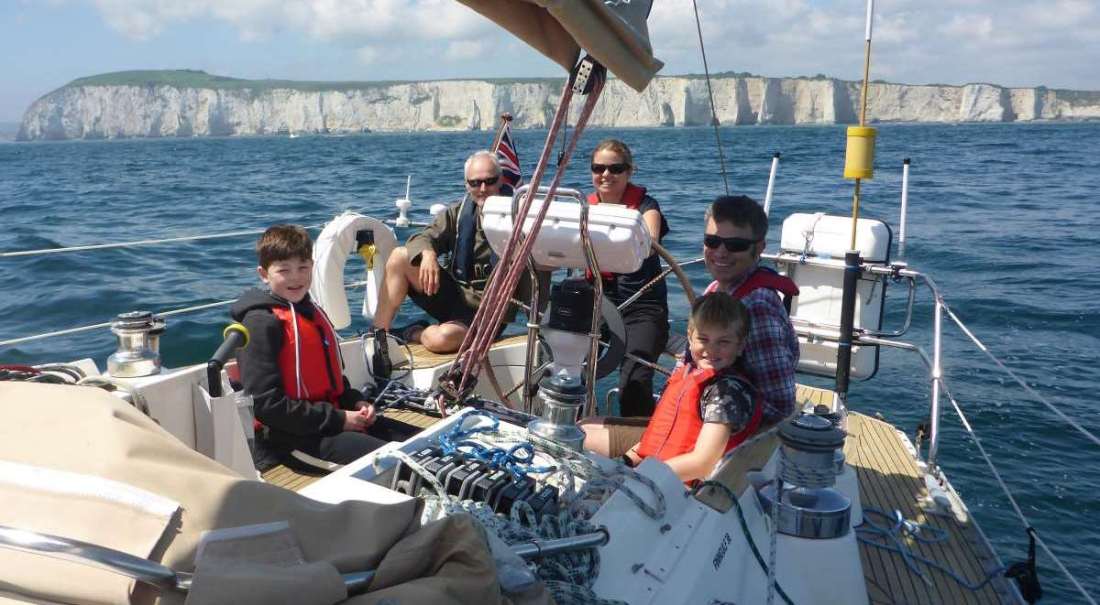
Although we weren’t able to get ashore in Poole, we were able to pick up Owain and family for a fun day out.  Owain claims they are sailing novices, but they seemed naturals to us, as we ran across to Swanage Bay for lunch rolling around at anchor, followed by a fun bit of tacking and jibing practice in the shadow of all those black-sailed racing yachts.  Returning to Poole to drop them off we couldn’t even get a temporary berth to drop off and had to resort to a rather unnerving landing at the town quay against the wall.  We have brought fender boards but didn’t have time to put them on before arriving at the wall.  Thanks to the friendly and helpful guy who grabbed our lines as we wondered how to reach a cleat that was far above our heads!

Day12 Picnic in Studland bay
With Owain and family

An idyllic day of toilet maintenance in Chichester harbour

It was all going well until Alex needed to go to the toilet.

We ran out of wind halfway between Brighton and Chichester.  Disappointing to have to put the engine on after sailing all the way from Gillingham but the alternative was missing the tide for the Looe channel north of Selsey Bill.  Without any wind, we would have found ourselves going backwards for the evening and we were already cold enough not to fancy it much.

As it was, we motored the 3 hours to Chichester, ‘put our foot down’ hard to get across the rapidly ebbing tide and scraped across the bar with 0.5m water under our keel to pick up a buoy off Hayling island.  Dinner at a relatively civilised 9pm, woke up to sun, views, little wind and the hope of a lazy day.

Then toilet trouble.  The thing was happy enough to pump matter out (thankfully!) but not to flush.  At least water for flushing is easy to come by, even if a bucket-over-the-side isn’t as convenient as a pump.  Presuming the inlet to be blocked, we started dismantling the pipework.  Pipes attached to holes below the waterline are secured with double jubilee clips, which becomes amusing when you find out how hard they are to shift.  Wrestling with them is unnerving because of the force it applies to the through-hull fitting – these are bullet proof when installed well and in good condition but you really don’t want one to fail.  Ours are metal and have spent the last 20 years in a corrosive marine environment.

The whole set-up is unsatisfactory on many fronts and is on our future projects list to sort out:

  1. A mix of metric and imperial sizes means nothing fits properly – things are either so tight they are near-impossible to remove or need tape to make them seat.
  2. The though-hull fitting is connected to a T-piece (as the salt water is used both by the toilet flush and a salt water rinse in the galley). The geometry is too complicated and hard to clear.
  3. You can’t unscrew the T-piece because it fouls the handle on the seacock. Didn’t really fancy dismantling that, but there didn’t seem to be much of an alternative.
  4. Best of all, the inlet for the toilet flush and galley is about 6” in front of the discharge from the toilet. Fantastic!!  Noted not to use the toilet and the galley at the same time…
Day 6 Seaweed
Seaweed prior to repatriation. How did he manage to suck all that into the pipe?

With everything in pieces, we recovered a reasonable quantity of seaweed and blew the rest back out through the seacock.  Hadn’t realised the stuff was so effective for plugging holes, might keep some in our emergency kit in future.  Finally, as we’d got all the cushions up in the aft cabin, we did some engine checks.  It was the first decent run for the engine and it looks fine.  Good news after all.  Time for tea and the rest of Jerry’s ginger biscuits.  Just need to go to the toilet first…